Report by the Central Board of Health of Jamaica / presented to the legislature under the provisions of the 14th Vic. chap. 60, and printed by order of the Assembly.
- Jamaica. Central Board of Health
- Date:
- 1852
Licence: Public Domain Mark
Credit: Report by the Central Board of Health of Jamaica / presented to the legislature under the provisions of the 14th Vic. chap. 60, and printed by order of the Assembly. Source: Wellcome Collection.
Provider: This material has been provided by King’s College London. The original may be consulted at King’s College London.
476/594 (page 166)
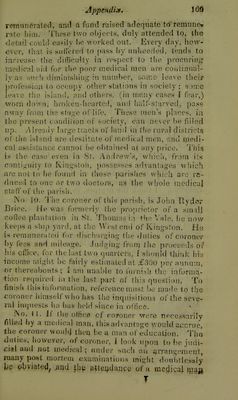
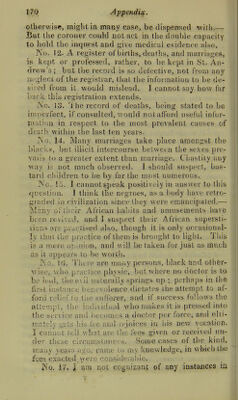
![of that is (liJlirnU of access, the mountains being hig;h and .ste« ]). Some of the main roads in the lowlands are passably good, but those in the uplands are in very bad order, some of them nearly impassable. • IS^). 2. Tho. population of 8t. Andrew's, before the \isitation of cholera,, was estimated at near twenty thousand. Ihe ascertained deaths from cholera i have understoo(i to be about one tenth. The chole- ra piincipally aOected the lower orders of hociejy, and the occupation of that part of the communily in tliis parisli is agriculture. I am unable to state which of the sexes suflered most from ihe pestilence, my imjjression is that they sufl'ered equally. ' No. .3. The su,u.:.ir OS J a(es in existence in tin's pa- rish, twenty years ai^o, were Constant Spring ; Little Spring; Norbrook ; Cherry Garden ; Somerset; Bar- bican; Hope; .Mona; Papine; Molynes; jMaverly ; Chancery Hall ; VvliiteHali; Pembroke Hall; Wa- terhouse; Temple Ball; Golden Spring ; Hall's De- light. All of these have been thrown up but Con- stant Spring ; Cherry Garden ; Molynes ; Golden Spring; ]N'ori)rook ; Mona ; and Temple Hall. In order to cultivate tiiese and the few coffee planta- tions still continued in cultivation, the agricultural population is fully adequate, but then that po[>uia- tion is, for the most part, scattered about. Some of the labourers cultivate their own little freeholds, and some occupy the lands of the proprietary as tenants, cultivating the esculent loots of the country, &c. to maintain themselves. AVith some very rare excep- tions they are a worthless class of persons, idle, im- provident, and sadly debauched. No. 4. 1 am unable to reply confidently to this question. Before the occurrence of cholera, day la- bour was reduced to nine-pence, but I have reason to think that labour cannot now be procured readily at that rate, especially in the lowland part of this pa- rish. In the u|)iand eastern district, w here the cli- mate and soil are pecubarly adapted to the growth Sind cultivation of coffee, I believe labour is still pro-](https://iiif.wellcomecollection.org/image/b21297599_0476.jp2/full/800%2C/0/default.jpg)