[Report 1935] / School Medical Officer of Health, Scarborough.
- Scarborough (England). Council.
- Date:
- 1935
Licence: Attribution 4.0 International (CC BY 4.0)
Credit: [Report 1935] / School Medical Officer of Health, Scarborough. Source: Wellcome Collection.
25/30 (page 23)
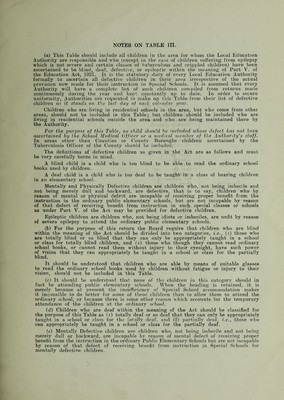
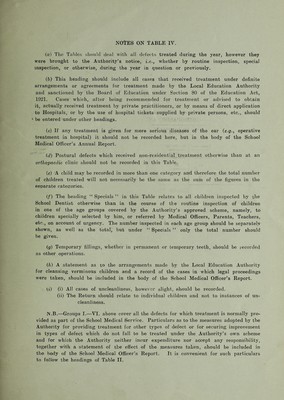
![(a) This Table should include all children in the area for whom the Local Education Authority are responsible and who (except in the case of children suffering from epilepsy which is not severe and certain classes of tuberculous and crippled children) have been ascertained to be blind, deaf, defective, or epileptic within the meaning of Part V. of the Education Act, 1921. It is the statutory duty of everj^ Local Education Authority formally to ascertain all defective children in their area irrespective of the actual provision now made for their instruction in Special Schools. It is assumed that every Authority will have a complete list of such children compiled from returns made continuously during the year and kept constantly up to date. In order to secure uniformity, Authorities are requested to make up this Table from their list of defective children as it stands on the last day of each calendar year. Children who are living in residential schools in the area, but who come from other areas, should not be included in this Table; but children should be included who are living in residential schools outside the area and who are being maintained there by the Authority. For the purpose of this Table, no child should he included whose defect has not been ascertained by the School Medical Officer or a medical member of the Authority’s staff. In areas other than Counties or County Boroughs children ascertained by the Tuberculosis Officer of the County should be included. The definitions of defective children as given in the Act are as follows and must be very carefully borne in mind. ^ A blind child is a child who is too blind to be able to read the ordinary school books used by children. A deaf child is a child who is too deaf to be taught in a class of hearing children in an elementary school. Mentally and Phj’sically Defective children are children who, not being imbecile and not being merely dull and backward, are defective, that is to say, children who by reason of mental or physical defect are incapable of receiving pro];>er benefit from the instruction in the ordinary public elementary schools, but are not incapable by reason of that defect of receiving benefit from instruction in such special classes or schools as under Part V. of the Act may be provided for defective children. Epileptic children are children who, not being idiots or imbeciles, are unfit by reason of severe epilepsy to attend the ordinary public elementary schools. (b) For the purpose of this return the Board require that children who are blind within the meaning of the Act should be divided into two categories, i.e., (i) those who are totally blind or so blind that they can only be appropriately taught in a school or class for totally blind children, and (2) those who though they cannot read ordinai-y school books, or cannot read them without injury to their eyesight, have such power of vision that they can appropriately be taught in a school or class for the partially blind. It should be understood that children who are able by means of suitable glasses to read the ordinary school books used by children without fatigue or injury to their vision, should not be included in this Table. (c) It should be understood that none of the children in this category should in fact be attending pxiblic elementary schools. When the heading is retained, it is merely because at present the insufficiency of Special School accommodation makes it imiiossible to do better for some of these children than to allow them to attend the ordinary school, or because there is some other reason vhich accounts for the temporary attendance of the children at the ordinary school. (d) Children who are deaf within the meaning of the Act should be classified for the purpose of this Table as (i) totally deaf or so deaf that they can only be appropriately taught in a school or class for the totally deaf, and (2) partially deaf, i.e., those who can appropriately be taught in a school or class for the partially deaf. (e) Mentally Defective children are children who, not being imbecile and not being merely dull or backward, are incapable by reason of mental defect of receiving proper benefit from the instruction in the ordinary Public Elementary Schools but are not incapable by reason of that defect of receiving benefit from instruction in Special Schools for mentally defective, children.](https://iiif.wellcomecollection.org/image/b30073212_0025.jp2/full/800%2C/0/default.jpg)