The flora of the Assyrian monuments and its outcomes / by E. Bonavia.
- Emanuel Bonavia
- Date:
- 1894
Licence: Public Domain Mark
Credit: The flora of the Assyrian monuments and its outcomes / by E. Bonavia. Source: Wellcome Collection.
208/256 (page 170)
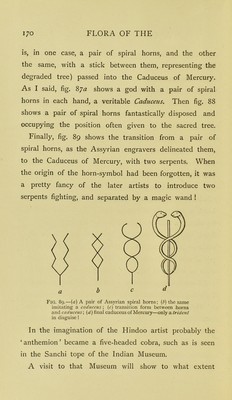
![is, in one case, a pair of spiral horns, and the other the same, with a stick between them, representing the degraded tree) passed into the Caduceus of Mercury. As I said, fig. Zja shows a god with a pair of spiral horns in each hand, a veritable Caduceus, Then fig. 88 shows a pair of spiral horns fantastically disposed and occupying the position often given to the sacred tree. Finally, fig. 89 shows the transition from a pair of spiral horns, as the Assyrian engravers delineated them, to the Caduceus of Mercury, with two serpents. When the origin of the horn-symbol had been forgotten, it was a pretty fancy of the later artists to introduce two serpents fighting, and separated by a magic wand ! Fig. 89.—[cl] ^ pair of Assyrian spiral horns; (^) the same imitating a caduceus ; (c) transition form between horns and caduceus; {d) final caduceus of Mercury—only a trideni in disguise ! In the imagination of the Hindoo artist probably the ‘ anthemion ’ became a five-headed cobra, such as is seen in the Sanchi tope of the Indian Museum. A visit to that Museum will show to what extent](https://iiif.wellcomecollection.org/image/b24854852_0208.jp2/full/800%2C/0/default.jpg)