The flora of the Assyrian monuments and its outcomes / by E. Bonavia.
- Emanuel Bonavia
- Date:
- 1894
Licence: Public Domain Mark
Credit: The flora of the Assyrian monuments and its outcomes / by E. Bonavia. Source: Wellcome Collection.
229/256 (page 191)
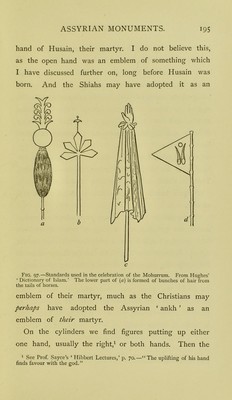
![I think that the date tree in {d) shows us plainly what the middle prong of the trident, pentadent, and ‘ fleur-de-lys,’ mean ; it stands for the degraded stem of the tree. Sometimes, by further degradation, the remnants of the tree disappear, and we have the horns alone, as in [i] and {71). We commence now to see how the superstition of placing horns on date trees to protect them from the evil eye, in being translated into pictures and hard stone seals, began to be degraded, and eventually passed into a symbol. On large spaces, such as those of the British Museum sculptures, the artist had plenty of room for full display ; but the engraver of seals, with his small spaces, hard stones, and rude tools, must often have been in difficulties. Degradation of the tree followed ; but the important part of the combina- tion—the horns—could not be left out. They were the great charm for keeping away the troubles of the evil eye, or of other devils; and so the tree became reduced, and sometimes was left out altogether. The tree and horns then passed into a simple symbol, modi- fied in numerous ways, according to the fancy of the designer. Eventually a thing incomprehensible, but mystically of great importance, was naturally taken up as the badge of royalty—of auttiority. And so we find the ‘ankh,’ held in the hand of Egyptian gods, the sceptre](https://iiif.wellcomecollection.org/image/b24854852_0229.jp2/full/800%2C/0/default.jpg)