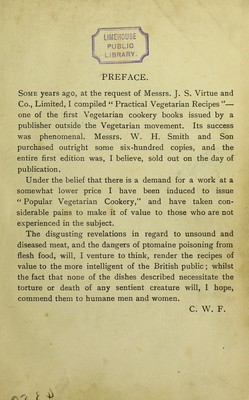
Popular vegetarian cookery : comprising upwards of one hundred and twenty specially selected recipes / compiled by Charles W. Forward.
- Q81121011
- Date:
- [not before 1898]
Licence: Public Domain Mark
Credit: Popular vegetarian cookery : comprising upwards of one hundred and twenty specially selected recipes / compiled by Charles W. Forward. Source: Wellcome Collection.
Provider: This material has been provided by The University of Leeds Library. The original may be consulted at The University of Leeds Library.
6/62 (page 6)
![manufacture of wheat into fine flour for the purpose of making white bread. In selecting his foods the vegetarian novice should arrange his dietary so as to include each of these classes. Thus, he should not choose for dinner pea soup, haricot stew, and toasted cheese, or the nitrogenous element will become a burden to him. Au confraire, if he take barley soup, macaroni, and tapioca pudding, he will possibly find the nitrogenous portion insufficient. One dish should be largely nitrogenous, if any physical work has to be done. If much physical work is required, a soup and savoury, both nitrogenous {e.g., pea soup and lentil stew), might be chosen. A desirable choice would be a slightly nitrogenous or non-nitrogenous soup, such as hotch-potch or barley soup; a semi-nitrogenous savoury, such as haricot pie, with a little oil added; and a simple carbonaceous pudding (macaroni, rice, or tapioca) with stewed fruit. In winter oatmeal porridge, with butter and sugar, might replace the soup. In regard to quantity it may be laid down as an axiom that there is a definite ration of food required by every man, woman, and child; a dietary that both with regard to]quality and quantity is best suited to the requirements of their systems, and it is likely enough that not one person in a thousand has discovered what his particular ration should be, nor has the faintest idea how to arrive at such a conclusion. Some eat too much fpod all round, and others eat too little. Yet, again, others eat too much of some particular elements of food and not sufficient of other elements, with consequent injury to health. In point of fact, almost every one who has given the subject of diet a thought, has felt the need for some data to work upon. The question now arises, “ Are such data accessible to the ordinary man or woman, or does one need to study anatomy, physiology, chemistry, and perhaps half-a-dozen other branches of science, in order to grasp the subject ? and it may be at once replied, that a little intelligent study of a few comparatively simple facts and figures, together with their application to one’s own habits of life, is all that is necessary to the formation of tolerably clear ideas upon this subject.](https://iiif.wellcomecollection.org/image/b21538219_0010.jp2/full/800%2C/0/default.jpg)