Licence: Public Domain Mark
Credit: The smoker's text book / by J. Hamer. (A reprint). Source: Wellcome Collection.
30/172 page 14
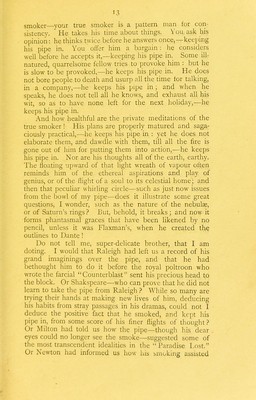
![his profound comprehension of the celestial mechanism. Or Robert Hall—ah ! you should have heard him preach after a pipe thrice filled, to have known what pulpit eloquence was ! Or Campbell—who ever equalled him for the true fire of a lyric ? The secret of it was—he smoked, and kept his pipe in. Or Tennyson—do not all our living poets pale their smaller fires before him ? What wonder ? he smokes, and keeps his pipe in. Or Carlyle—by whose electric words your brain is stirred, your prejudices are shattered, your heart is fired with indignation against idle shams, and your resolution is girt up to work and be no sham; and why ?—he smokes, and keeps his pipe in. q. e. D. It is all as clear as the sun in a cloudless sky at a July noon : and the whole host of ye, abstainers of every degree, must be as blind as moles, bats, or owls, if you cannot see it. Do not bother Adam Hornbook with any more of your abstinences—unless they have more sense to recommend them than any you have hitherto recommended—for Adam’s mind is made up. While he is able, he will smoke and keep his pipe in.— Thomas Cooper’s “ Family Feud.” A PIPE ! it is a great comforter, a pleasant soother! Blue devils fly before its honest breath ! It ripens the brain, it opens the heart; and the man who smokes, thinks like a sage, and acts like a Samaritan.—Bulweds “ Night and Morning SMOKING SPIRITUALIZED. [The following old poem was long ascribed, on apparently sufficient grounds to the Rev. Ralph Erskine, or, as he designated himself, “ Ralph Erskine, V.D.M.” The peasantry throughout the North of England always called it’“Erskine Song; and not only is his name given as the author in numei ^us chap-books, but in-his own volume of “Gospel Sonnets, from an early copy of which our version is transcribed. The discovery, how- ever, by Mr. Collier, of the First Part in a MS. temp. Jac. I., with the initials G. W. affixed to it, has disposed of Erskine’s name to the honour of the entire authorship. G. W. is supposed to be George Wither, but this is purely conjectural, and it is not at all improbable that (». VV. really stands for W. G., as it was a common practice amongst anonymous writers to reverse their initials. The history, then, of the poem seems to be this. that the First Part, as it is now printed, originally constituted the who e production, being complete in itself: that the Second Part was afterwards added by the Rev. Ralph Erskine, and that both parts came subsequent.}- to be ascribed to him, as his was the only name published in connexion with the song.—See “ Ballads of the Peasantry. Bell s edition.]](https://iiif.wellcomecollection.org/image/b28141775_0030.jp2/full/800%2C/0/default.jpg)




 No text description is available for this image
 No text description is available for this image
 No text description is available for this image