Blackwater fever in the tropical African dependencies : reports for 1912.
- House of Commons
- Date:
- 1914
Licence: In copyright
Credit: Blackwater fever in the tropical African dependencies : reports for 1912. Source: Wellcome Collection.
Provider: This material has been provided by London School of Hygiene & Tropical Medicine Library & Archives Service. The original may be consulted at London School of Hygiene & Tropical Medicine Library & Archives Service.
39/204 page 25
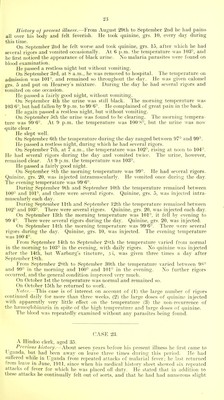
![rectum. Three injections of strychnine, gr. ..'„, were given during the day, and an injection of morphia, gr. I, at night. He slept well. Auo-. 28th : The temperature ranged between 94-6° and 100° during the day. The pulse rate was 124. There was no vomiting, and he was able to take sufficient nourishment by the mouth. Two injections of strychnine were given, and the saline enemata were continued. During the night there was some vomiting, the patient had little sleep and became restless and excited, resisting all attempts to give nourishment by either mouth or rectum. He spat out all food put into his mouth, and said that he wanted to die. Aug. 29th : The morning temperature was 101°, the pulse rate 130. Vomiting occurred several times. Later in the day he became less restless and took a table- spoonful of milk, but spat out the rest. A soap and water enema was given followed, after it had had the required effect, by nutrient enemata. At 4 p.m. the pulse, 140 to 150 beats to the minute, was almost imperceptible. One pint of normal saline solution was injected subcutaneously into the chest-wall, after which the pulse rate came down to 120. At 8.30 p.m. the temperature was 102'8°, the pulse, 140 beats to the minute, stronger. During the evening he took a little milk at intervals. Two injections of strychnine, gr. Jq, and one of quinine, grs. 10, w^ere given during the day, and an injection of morphia, gr. ^, was given at night. (He slept well till 2 a.m.) Aug. 30th : From 2 a.m. onwards he was restless. He refused to be given nutrient enemata but took sufficient milk by the mouth. The temperature during the day ranged between 101° and 1045°, and the pulse rate between 130 and 101. The pulse was less irregular. Quinine, grs. 10, was injected. Strychnine, gr. was injected three times. He complained of great pain in the stomach. He slept well, and there was no vomiting during the night. Aug. 31st. A soap and water enema was given with good result. The temperature ranged between 99'8° and 1008° and the pulse rate between 116 and 130. An enema of normal saline solution was given. Strychnine was injected three times. An intramuscular injection of quinine, grs. 10, was given once and morphia, gr. ^, was injected at night. He slept fairly well till 3.30 a.m. Sept. 1st: After 3.30 a.m. he became restless and feverish, and vomited several times. The morning temperature was 103'8° and the pulse rate 130. Quinine, grs. 20, was injected intramuscularly. Vomiting continued, and he refused to be given nutrient enemata. The evening temperature was 100'6°, the pulse rate 120. After 9 p.m. he was able to keep down a little milk and soda w^ater. One injection of strychnine was given during the day. During the night he vomited several times, but slept at intervals. Sept. 2nd: The temperature during the day ranged bet^veen 98'4° and 98'6°; the pulse rate was 120. Quinine, grs. 20, was injected intramuscularly. He vomited two or three times during the day, but kept down a little milk and soda water. He refused to be given nutrient enemata. Morphine, gr. \, was given hypodermically at night. He passed a restless night, vomiting at intervals. Sept. 3rd : During the day the tem]:)erature ranged between 98° and 99° and the pulse rate between 112 ancl 120. Saline enemata w^re given. Although there was no vomiting during the day the patient refused to take anything by the mouth. He slept fairly well. Sept. 4th: The morning temperature was 99-6° and the pulse rate 130. Respirations 40 to the minute. There were signs of hypostatic congestion at the bases of both lungs. He was propped up in bed at intervals for a few minutes. He began to ramble in talk, and was quite unable to understand and answer questions. In the afternoon the temperature fell to below normal, the pulse became very weak, irregular, and difficu.lt to count. Throughout the day he was given brandy and milk in small quantities, and the liquor strycJmirice hydrocMoridi, ni 4 by the mouth. There was no vomiting. At 7.45 p.m. the pulse, 124 beats to the minute, was less irregular. He now felt cold, and appeared to be falling into a state of collapse. Brandy and hot milk were given, and hot bottles were applied to tlie feet and body. At 9.30 p.m. he was in a more or less collapsed semi-conscious condition. Teaspoonful doses of hot milk and brandy were continued. He went .S1857 n](https://iiif.wellcomecollection.org/image/b21352793_0039.jp2/full/800%2C/0/default.jpg)