A text-book of dental pathology and therapeutics : for students and practitioners / by Henry H. Burchard ; revised by Otto E. Inglis.
- Burchard, Henry H.
- Date:
- 1905
Licence: In copyright
Credit: A text-book of dental pathology and therapeutics : for students and practitioners / by Henry H. Burchard ; revised by Otto E. Inglis. Source: Wellcome Collection.
Provider: This material has been provided by The University of Glasgow Library. The original may be consulted at The University of Glasgow Library.
55/684 page 51
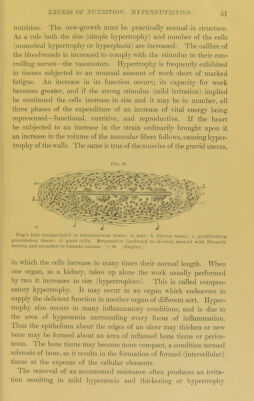
![I EXCESS OF NUTRITION. IIYPERNUTRITION. 51 j nutrition. The new-growth must be practically normal in structure. ! As a rule both the size (simple hypertrophy) and number of the cells (numerical hypertrophy or hyperplasia) are increased. The calibre of the bloodvessels is increased to comply with the stimulus to their con- trolling nerves—the vasomotors. Hypertrophy is frequently exhibited \ in tissues subjected to an unusual amount of work short of marked j fatigue. An increase in its function occurs; its capacity for work ! becomes greater, and if the strong stimulus (mild irritation) implied ' be continued the cells increase in size and it may be in number, all ! three phases of the expenditure of an increase of vital energy being I represented—functional, nutritive, and reproductive. If the heart \ be subjected to an increase in the strain ordinarily brought upon it | an increase in the volume of the muscular fibres follows, causing hyper- ] trophy of the walls. The same is true of the muscles of the gravid uterus, Fig. 26. Dog'.s hair encapsulated in subcutaneou.s tissue: a, hair; h, fibrous tissue; c, proliferating srranulation ti.ssue; d, giant cells, yreparation hardened in alcohol, stained with Bismark ! brown, and mounted in Canada balsam. X 06. (Ziegler.) ' I i in which the cells increase to many times their normal length. When i one organ, as a kidney, takes up alone the work usually performed \ by two it increases in size (hypertrophies). This is called compen- : satory hypertrophy. It may occur in an organ which endeavors to supply the deficient function in another organ of difi'erent sort. Hyper- j trophy also occurs in many inflammatory conditions, and is due to ] the area of hypersemia surrounding every focus of inflammation. Thus the epithelium about the edges of an ulcer may thicken or new i bone may be formed about an area of inflamed bone tissue or perios- j teum. The bone tissue may become more compact, a condition termed I sclerosis of bone, as it results in the formation of formed (intercellular) i tissue at the expense of the cellular elements. The removal of an accustomed resistance often produces an irrita- tion resulting in mild hypei\nemia and thickening or hypertrophy](https://iiif.wellcomecollection.org/image/b21449557_0055.jp2/full/800%2C/0/default.jpg)
 No text description is available for this image
 No text description is available for this image
 No text description is available for this image