Volume 1
Lectures on the principles and practice of physic : delivered at King's College, London / by Sir Thomas Watson.
- Sir Thomas Watson, 1st Baronet
- Date:
- 1871
Licence: Public Domain Mark
Credit: Lectures on the principles and practice of physic : delivered at King's College, London / by Sir Thomas Watson. Source: Wellcome Collection.
Provider: This material has been provided by King’s College London. The original may be consulted at King’s College London.
67/936 page 47
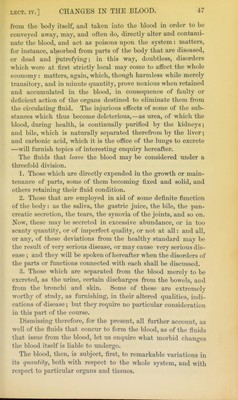
![LECT. IV.] CHANGES IN THE BLOOD. from the body itself, and taken into the blood in order to be conveyed away, may, and often do, directly alter and contami- nate the blood, and act as poisons upon the system: matters, for instance, absorbed from parts of the body that are diseased, or dead and putrefying; in this way, doubtless, disorders which were at first strictly local may come to affect the whole economy : matters, again, which, though harmless while merely transitory, and in minute quantity, prove noxious when retained and accumulated in the blood, in consequence of faulty or deficient action of the organs destined to eliminate them from the circulating fluid. The injurious effects of some of the sub- stances which thus become deleterious,—as urea, of which the blood, during health, is continually purified by the kidneys; and bile, which is naturally separated therefrom by the liver; and carbonic acid, which it is the office of the lungs to excrete —will furnish topics of interesting enquiry hereafter. The fluids that leave the blood may be considered under a threefold division. 1. Those which are directly expended in the growth or main- tenance of parts, some of them becoming fixed and solid, and others retaining their fluid condition. 2. Those that are employed in aid of some definite function of the body: as the saliva, the gastric juice, the bile, the pan- creatic secretion, the tears, the synovia of the joints, and so on. Now, these may be secreted in excessive abundance, or in too scanty quantity, or of imperfect quality, or not at all: and all, or any, of these deviations from the healthy standard may be the result of very serious disease, or may cause very serious dis- ease ; and they will be spoken of hereafter when the disorders of the parts or functions connected with each shall be discussed. 3. Those which are separated from the blood merely to be excreted, as the urine, certain discharges from the bowels, and from the bronchi and skin. Some of these are extremely worthy of study, as furnishing, in their altered qualities, indi- cations of disease; but they require no particular consideration in this part of the course. Dismissing therefore, for the present, all further account, as well of the fluids that concur to form the blood, as of the fluids that issue from the blood, let us enquire what morbid changes the blood itself is liable to underjjo. The blood, then, is subject, first, to remarkable variations in its quantity, both with respect to the whole system, and with respect to particular organs and tissues.](https://iiif.wellcomecollection.org/image/b2129253x_0001_0067.jp2/full/800%2C/0/default.jpg)