The anatomy of humane bodies, with figures drawn ... by some of the best masters in Europe ... To which is added an introduction explaining the animal oeconomy / Revised and publish'd by C.B. Albinus.
- William Cowper
- Date:
- 1737
Licence: Public Domain Mark
Credit: The anatomy of humane bodies, with figures drawn ... by some of the best masters in Europe ... To which is added an introduction explaining the animal oeconomy / Revised and publish'd by C.B. Albinus. Source: Wellcome Collection.
25/380
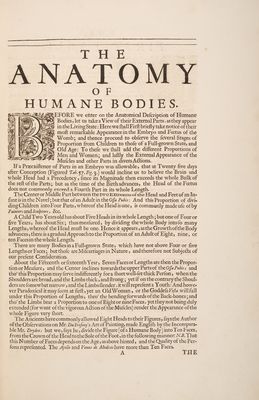
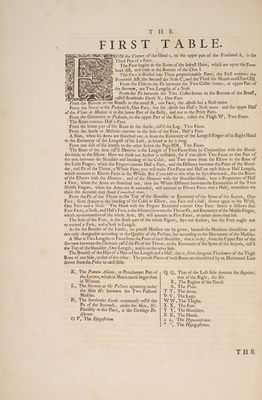
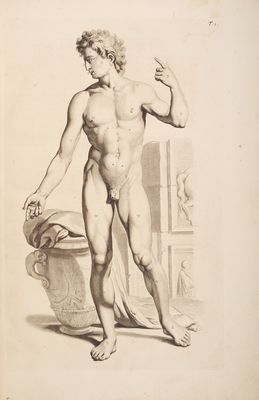
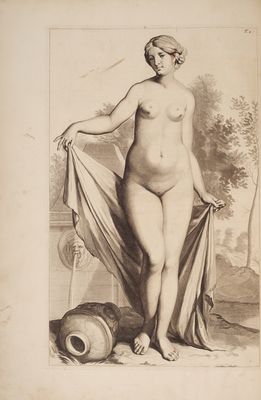
![HUMANE BODIES. =a EFORE we enter on the Anatomical Defcription of Humane “4 Ifa Preexiftence of Parts in an Embryo was allowable, that at Twenty five days after Conception (Figured Tab.§7. Fig. 3.) would incline us to believe the Brain and whole Head had a Precedency ; fince its Magnitude then exceeds the whole Bulk of the reft of the Parts; but as the time of the Birthadvances, the Head of the Foetus does not commonly exceed a. Fourth Part in its whole Length. | _ The Center or Middle Part between the two Extreams of the Head and Feet of an Inz fant isin the Navel; but that ofan Adultin the Of Pubis: And this Proportion of divi- ding Children into Four Parts, whereof the Head isone, is commenly made ufe of by Painters and Sculptors, &c. A Child Two Years old has about Five Heads in its whole Length ; but one of Four or five Years, has aboutSix; thusmeafured, by dividing the whole Body intofo many Lengths, whereof the Head muft be one. Hence it appears ,asthe Growth of the Body advances, there is a gradual Approachto the Proportion of an Adultof Eight, nine, or ten Facesin the whole Length. | There are many BodiesinaFull-grown State, which have not above Four or five Lengthsor Faces; but thofe are Mifcarriagesin Nature, andtherefore not Subjects of our prefent Confideration. About the Fifteenth or fixteenth Year, Seven Faces or Lengths are then the Propor- tion or Meafure, and the Center inclines towardsthe upper Parts of the Offa Pubiss and tho’ this Proportion may ferve indifferently fora fhort well-fet thick Perfon, when the Shoulders are broad, and the Limbs thick, and ftrong ; yetif on the contrary the Shoul- ders are fomewhat narrow, and the Limbs flender, it willreprefenta Youth: And howe- ver Paradoxical it may feem at firft, yet an Old Woman, or the Goddefs Ve? will fall under this Proportion of Lengths, thro’ the bending forwards of the Back-bones ; and tho’ the Limbs bear a Proportion to one of Eight or nine Faces, yet they not being duly extended (for want of the vigorous Action of the Mufcles) render the Appearance of the whole Figure very fhort.. | The Ancients have commonly allowed Eight Heads to their Figures, faysthe Author of the Obfervations on Mr. Dz Frefnoy’s Art of Painting, made Englifh by the Incompara- ble Mr. Dryden; but we, fays he, divide the Figure | ofa Humane Body] into Ten Faces, from the Crown of the Head to the Sole of the Foot, in the following manner: N.B. That this Number of Faces dependson the Age, asabove hinted, and the Quality of the Per- fons reprefented. The Apollo and Venus de Medices have more than Ten Faces. race A](https://iiif.wellcomecollection.org/image/b33544335_0025.jp2/full/800%2C/0/default.jpg)
 No text description is available for this image
 No text description is available for this image
 No text description is available for this image