A treatise on medical jurisprudence / by Francis Wharton and Moreton Stillé ; the medical part revised and corrected, with numerous additions by Alfred Stillé.
- Francis Wharton
- Date:
- 1860
Licence: Public Domain Mark
Credit: A treatise on medical jurisprudence / by Francis Wharton and Moreton Stillé ; the medical part revised and corrected, with numerous additions by Alfred Stillé. Source: Wellcome Collection.
Provider: This material has been provided by the National Library of Medicine (U.S.), through the Medical Heritage Library. The original may be consulted at the National Library of Medicine (U.S.)
113/1074
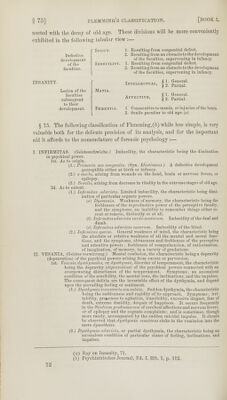
![BOOK. I.] FLEMMING'S CLASSIFICATION. [§ 76 (a) Atra (the Melancholia Lypemonia, of Esquirol), or gloomy Dysthymia, the characteristic being sadness, fear, dread, sus- picion, malevolence, homesickness {nostalgia), and the wild- ness and ferocity of the intoxicated. (Ferocitas et morositas ebriosorum. (b) Dysthymia Candida, cheerful Dysthymia {Melancholia hilaris, Chmromanie Chambeyron), the characteristics being hilarity, recklessness of manner, raillery, proneness to see all things in the most vivacious light. (c) Dysthymia mutabilis, variable Dysthymia, the characteristic being vacillation between the two foregoing forms. (3.) Dysthymia sparsa (apathica), general Dysthymia (Melancholia Atto- nita). The characteristics being, apparent obtuseness, dull, heavy reveries and abstractions, prevalence of an indistinct sensation of dis- comfort, apathy to all extraneous impressions. 2d. Vesania Annoetos, or Anoesia. Disturbance of the understanding. The cha- racteristics being the depravity (depravation) of the psychical powers, with a controlling anomalousness of the intellectual faculties. Symptoms, deliria of various kinds, with manifestations of Dysthymia, which, however, are merely subordinate. (1.) Anoesia Transitoria, or Subita. Sudden Anoesia. The characteristics being unexpected appearance and rapid subsidence. (a) Anoesia efebre. Febrile delirium. (b) Anoesia e potu nimio (ebrietas). Drunkenness. (c) Anoesia ex affectu, madness caused by agitation of mind. (d) Anoesia semisomnis. Confusion of mind in sleep. Sleep-drunk- enness. (e) Anoesia Somnambnla, or Spastica; Somnambulism. (2.) Anoesia continua, chronic Anoesia. (3.) Anoesia remittens. Remittent Anoesia. (4.) Anoesia adstricta, partial Anoesia or Lunacy. The characteristics being delirium in particular intellectual departments. (a) Anoesia ad sensationes. Hallucinations (deliria of the senses). (Var. afallacia sensuum et hallucinatio ebriosorum), derange- ment of the senses consequent on excess of drinking. (b) Anoesia ad cogitationes, eccentricity, fixed insane ideas. (5.) Anoesia sparsa. General Anoesia or lunacy, the characteristics being Deliria in every department of the intellectual faculties. Var. a Anoesia potatorum (Delirium tremens). 3d. Vesania maniaca seu Mania. The characteristic being a depravity (deprava- tion) of the psychical functions, with a concurrent anomalousness of the emotional and intellectual faculties. The symptoms are a violent and perverse temper, inclinations and impulses, with violent deliria, which mutually sustain and aggravate each other. (1.) Mania transitoria subita, sudden mania, the characteristic being a sud- den breaking out of mania without perceptible premonitory stages, and without previous Dysthymia or Anoesia; generally a crisis in sleep, or transition to the second class. (a) Mania subita a febre (Delirium enceplialiticum), sudden deli- rium, with feverish symptoms of the brain and nerves. (b) Mania subita a potu nimio, arisingfrom and duringintoxication. (c) Mania subita ex effectu, mania caused by excessive agitation of the affections. (d) Mania subita e partu, mania connected with parturition. (e) Mania subito e morbo occulto (vulgo), Amentia occulta, which also includes the previous species. (2.) Mania continua, permanent mania. (3.) Mania remittens, Remittent mania. (Remark—Remittent mania in re- mission turns into Anoesia, in some cases immediately into Dysthymia.) (4.) Mania, adstricta sen instinctiva. Moral Insanity. (Mania sine delirio of Pinel; Monomania instinctive of Marc ; Mania affectiva; Folie raisonante); the characteristics being insanity, apparently confined to specific morbid impulses. This class is almost always connected with the symptoms of Mania transitoria sen subita. (5.) Mania Sparsa, general mania is the characteristic, being a depravity (depravation) of both the moral and intellectual powers. § TG. To Ellinger(c) we are indebted for the following :— I. Diseases of the affections, when the affections, sentiments and desires are preponderatingly alienated, while the intellectual faculties are affected in an inferior or at least a secon- dary degree. (0 Ueber die antropologischen Momente der Zurechnungs faliigkeit. Ludwigsburg, 1846.](https://iiif.wellcomecollection.org/image/b21163571_0113.jp2/full/800%2C/0/default.jpg)

 No text description is available for this image
 No text description is available for this image
 No text description is available for this image