A treatise on medical jurisprudence / by Francis Wharton and Moreton Stillé ; the medical part revised and corrected, with numerous additions by Alfred Stillé.
- Francis Wharton
- Date:
- 1860
Licence: Public Domain Mark
Credit: A treatise on medical jurisprudence / by Francis Wharton and Moreton Stillé ; the medical part revised and corrected, with numerous additions by Alfred Stillé. Source: Wellcome Collection.
Provider: This material has been provided by the National Library of Medicine (U.S.), through the Medical Heritage Library. The original may be consulted at the National Library of Medicine (U.S.)
47/1074
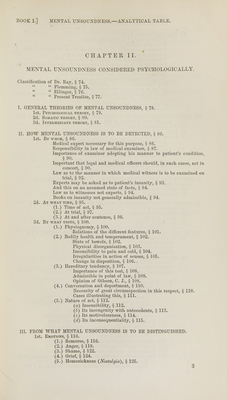
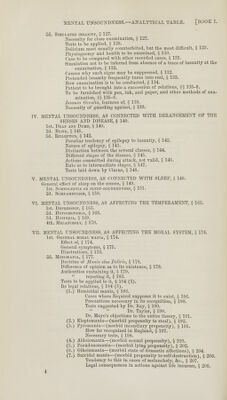
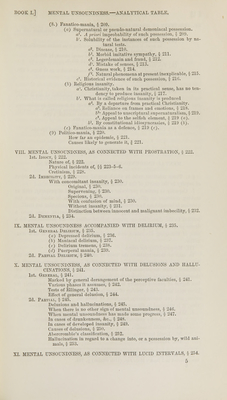
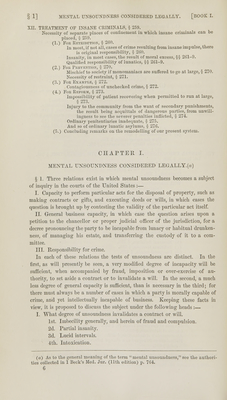
![BOOK I.] WHAT INVALIDATES A CONTRACT OR WILL. [§ 3 II. What is necessary to be proved in order to deprive a party of the man- agement of his estate. III. What degree of unsoundness avoids responsibility for crime. I. What degree of unsoundness invalidates a contract or will. § 2. With regard to lunatics or idiots, in the popular sense, there can be no question in this connection. Upon them the law affixes its visible stamp, and by virtue of a commission of lunacy,(aa) to be considered under the next head, pronounces them incapable of transferring property. Nor to invalidate their acts is it necessary that a decree of lunacy should have been actually pro- nounced. The madman, even though his madness be a mere temporary deli- rium, cannot, by an executory contract,(6) bind himself either in person or in property; and consequently in such a class of cases the judgment of the law must relieve him from responsibility. In this respect the test is the same in the criminal and the civil courts. There are, however, a large class of cases in which, as has been noticed, a contract or a will will be declared void, but in which there is a sufficient degree of intellect to create a responsibility for crime. These may be ranked as follows :— 1st. Imbecility generally, and herein of fraud and compulsion. 2d. Partial insanity. 3d. Lucid intervals. 4th. Intoxication. 1st. Imbecility generally, and herein of fraud and compulsion. § 3. Of this an illustration may be found in Lord Portsmouth's case, which has been too often erroneously supposed by medical writers to sustain the position, that mere mental debility is enough, by itself, to avoid even the most solemn contract. Lord Portsmouth was married for the second time in March, 1813, to a young woman who was the daughter of one of his trustees, the solicitor of the family, under whose charge he was at the time living. From earliest childhood he had displayed great weakness, both moral and mental, being cruel, timid, and fickle in his management of his household, and exceed- ingly capricious in his tastes. Upon his arrival at twenty-one, however, his (aa) A prior inquisition of lunacy is competent, but not conclusive evidence of inca- pacity (Whitenack v. Striker, 1 Green, C. R. 8), but even when the jury find that the lunacy was prior to the disputed act, and without lucid intervals, the finding may be collaterally impeached. (Rannatyne v. Bannatyne, 15 Jur. 804 ; 14 English R. 581.) (b) It should always be borne in mind, that in point of practice there is a great dis- tinction between contracts executed (i. e., those which have already been performed), and contracts executory (i.e., those whose performance is sought to be enforced). The latter a court will not in general lend its aid to execute, when the party sought to be affected was at the time a lunatic. But on the other hand, when in good faith a party makes a contract with a lunatic, supposing him to be of sound mind, and it is impossible to restore the parties to their original position, the contract cannot after- wards be rescinded and the purchase money or other consideration recovered back. (See Beavan v. M'Donnell, 24 English Rep. 48G ; S. C. 9 Wels. H. & G. 310; Molton v. Camroux, 2 Exch. R. 487, 4 Exch. R. 17; see also cases cited, 9 Wels H. & G. 314, n.)](https://iiif.wellcomecollection.org/image/b21163571_0047.jp2/full/800%2C/0/default.jpg)