On gall-stones and their treatment / by A.W. Mayo Robson.
- Robson, Arthur William Mayo, Sir, 1853-1933.
- Date:
- 1892
Licence: Public Domain Mark
Credit: On gall-stones and their treatment / by A.W. Mayo Robson. Source: Wellcome Collection.
Provider: This material has been provided by The University of Leeds Library. The original may be consulted at The University of Leeds Library.
87/314 (page 71)
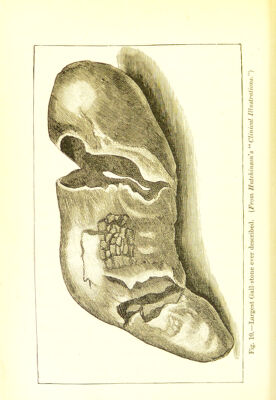
![4 Chap. III.] Pathological Considerations. 71 passed by the stone into the duodenum. It fell into three pieces on being taken out. The external surface resembled a very firm extract of liquorice. On some places there were evident marks of other stones adhering to it. The thick end of the stone was in the duodenum, the most pointed was turned towards the neck of the gall-bladder. The subject of the case Avas a man of forty, who died in the hospital at Goet- tingen in March, 1792. He had had jaundice for four 3^ears, and had been liable to colic, etc., much longer. His jaundice had increased of late, and he had had pains and feverishness. His whole body was of a dark yellow colour, and in some places even of a dark brown. His stools were white, and his urine contamed bile. Before death, bile returned in his stools. He had rigors and fever, with tramifovy blindness and verti(jo. During the last week he was always sleepy and often insensible. There was some vomiting. His abdomen was distended and his feet were swollen. After two or three days of insensibility, he had delirium and convulsions just before death. The liver was adherent to the parietes, etc. The gall-bladder was tivc inches long and two broad. It was full of dark bile, and contained thirty gall-stones. From](https://iiif.wellcomecollection.org/image/b21519079_0087.jp2/full/800%2C/0/default.jpg)