A treatise on mechanics, applied to the arts; including statics and hydrostatics / By the Rev. H. Moseley ... Published under the direction of the committee of General Literature and Education, appointed by the Society for Promoting Christian Knowledge.
- Henry Moseley
- Date:
- 1847
Licence: Public Domain Mark
Credit: A treatise on mechanics, applied to the arts; including statics and hydrostatics / By the Rev. H. Moseley ... Published under the direction of the committee of General Literature and Education, appointed by the Society for Promoting Christian Knowledge. Source: Wellcome Collection.
301/322 page 295
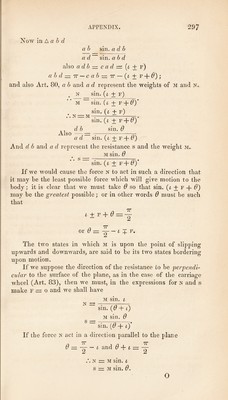
![, m,. p} m . o 7i + ?r2 ?/z,. ]), m9 . o «2 +. . m2. ?n{ + m2 ??z3 . p2 ?;z2 + • • • Whence observing that 0 «, = >», g, = 4 !»,/>, 0 ni—mtS, = knhP^ &c- also ?«, ?«., rrwp w — &c. * 2 2 3 we obtain 0 1 /h +/D + /A ^;{2 + • ■ • ~J)l VIr + p2 m.2 4 p3 ^3 +. . . This last furnishes an easy practical rule for finding the centre of gravity of an area of any form, however irregular; and one easily recollected. Divide it as above, into elements, by equidistant lines, called ordinates, perpendicular to a given axis. Take the sum of the squares of those ordinates, and divide it by their sum. Half the quotient will be the distance of the centre of gravity from the axis If the forces be now supposed to act perpendicularly to any other axis at right angles to the former, the distance of the centre of gravity from this axis may also be found. And thus its actual position will be ascertained. On tiie Direction op the Resistance of a Surface. (Note on Art. 72.) Let the coefficient of friction be represented by /. Let /r mp'— 0 (see fig. page 43. Art. 72.) The force p m or p is equivalent to q m and p'm. Now q, m p m sin. 6 p'm = p m cos. 6 Therefore resolved in the directions of qm and v' M, the values of p are p sin. f9, and p cos. 6. Now the power of resistance produced by friction is equal to the product of the coefficient of friction f by (he perpendicular force in p'm. It, therefore, equals /p cos. 6. Also the force tending to move the body is the force in the direction of q, m, and equals p sin. 6. Therefore the body will move, or not, according as psin. 6 {.*S 01,}>er /p cos. 6, l is not ’ J 5 or according as](https://iiif.wellcomecollection.org/image/b2932094x_0301.jp2/full/800%2C/0/default.jpg)