A treatise on mechanics, applied to the arts; including statics and hydrostatics / By the Rev. H. Moseley ... Published under the direction of the committee of General Literature and Education, appointed by the Society for Promoting Christian Knowledge.
- Henry Moseley
- Date:
- 1847
Licence: Public Domain Mark
Credit: A treatise on mechanics, applied to the arts; including statics and hydrostatics / By the Rev. H. Moseley ... Published under the direction of the committee of General Literature and Education, appointed by the Society for Promoting Christian Knowledge. Source: Wellcome Collection.
34/322 page 28
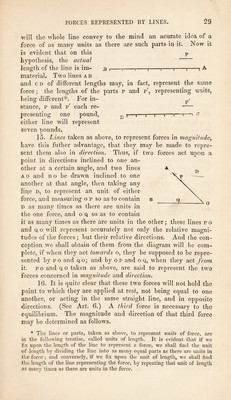
![7- If, instead of applying the two forces which are thus equal in opposite directions, we apply them] both in the same direction, the force which must be applied in an opposite direc¬ tion to sustain the two is said to be double of either of them. If we take a third force, equal to either of the two first, and apply the three in the same direction, the force which must be applied in the opposite direction to sustain the three, is said to be triple of either, and so for any number. 8. Thus, fixing upon any one force, and ascertaining how many forces equal to this are necessary, when applied in an opposite direction, to sustain any other force, we shall arrive at a true conception of the amount of that other force, in terms of the first, and may compare it with any third force whose amount has been ascertained by reference to the same standard. 9. The single force, in terms of which the amount of any other force is thus ascertained, is called an unit of force. 10. Forces, whose amount is ascertained in terms of some known unit of force, are said to be measured. 11. The units of force which it is found most convenient to use, are the weights of certain portions of matter, or the forces with which they tend towards the centre of the earth. The quantities of matter whose weights are used as units of force are different in different countries. 12. With us the unit of force, from which all the rest are derived, is the weight of 22'815* cubic inches of distilled water, called one pound troy. This being divided into 5760 equal parts, the weight of each is a grain troy, and 7000 such grains constitute the pound avoirdupois. 13. When we wish to represent the value of a force, we usually write down the number of the units contained in it; and annex to the figures expressing that number, the designation of each unit. Thus, 15 pounds avoirdupois, represents a force equivalent to fifteen units; each unit being one pound avoirdu¬ pois ; that is, each being the weight of a quantity of distilled water, found lay dividing 2285 cubic inches of it into 5760 equal parts, and taking one of these parts 7000 times. 14. Another method, however, of representing the value of a force may be conceived. b.-,-,-t-«-,-,-,A If we take a line a b, com¬ posed of any number of equal parts, and suppose each part to represent an unit; then * This standard is fixed by an Act of Parliament, bearing date June 25, 1824. The temperature is supposed to be 02° Fahrenheit, and the barometer to stand at 30 inches.](https://iiif.wellcomecollection.org/image/b2932094x_0034.jp2/full/800%2C/0/default.jpg)