On the horned cairns of Caithness : their structural arrangement, contents of chambers, &c. / by Joseph Anderson.
- Anderson, Joseph
- Date:
- 1868
Licence: Public Domain Mark
Credit: On the horned cairns of Caithness : their structural arrangement, contents of chambers, &c. / by Joseph Anderson. Source: Wellcome Collection.
Provider: This material has been provided by The Royal College of Surgeons of England. The original may be consulted at The Royal College of Surgeons of England.
18/36 page 494
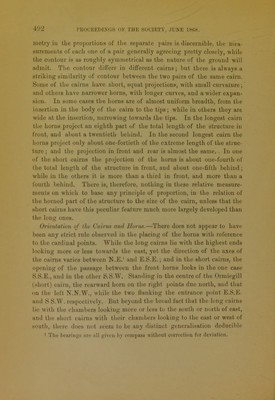
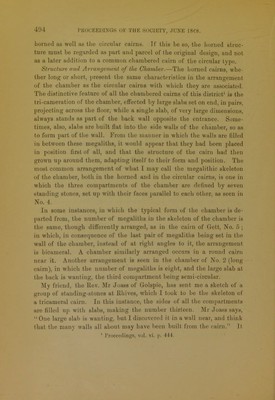
![horned as well as the circular cairns. If this he so, the horned struc- ture must be regarded as part and parcel of (he original design, and not as a later addition to a common chambereil cairn of the circular type. Structure ami Arrangement of the Chamber.—The horned cairns, whe- ther long or short, i)resent the same characteristics in the arrangement of the chamber as the circular cairns with which they are associated. The distinctive feature of all the chambered cairns of this district* is the tri-cameration of the chamber, effected by large slabs set on end, in jjuirs, projecting across the floor, while a single slab, of very large dimensions, always stands as part of the back wall opposite the entrance. Some- times, also, slabs are built flat into the side walls of the chamber, so as to form part of the wall. From the manner in which the walls are filled in between these megaliths, it would appear that they had been placed in position first of all, and that the structure of the cairn had then grown up around them, adapting itself to their form and position. The most common arrangement of what 1 may call the megalithic skeleton of the chamber, both in the horned and in the circular cairns, is one in which the three compartments of the chamber are defined by seven standing stones, set up with their faces parallel to each other, as seen in No. -1. In some instances, in which the typical form of the chamber is de- parted from, the number of megaliths in the skeleton of the chamber is the same, though differently arranged, as in the cairn of Gett, No. Ti; in which, in consequence of the last pair of megaliths being set in the wall of the chamber, instead of at right angles to it, the arrangement is bicameral. A chamber similarly arranged occurs in a round cairn near it. Another arrangement is seen in the chamber of No. 2 (long cairn), in which the number of megaliths is eight, and the large slab at the back is wanting, the third compartment being semi-circular. My friend, the Rev. 31 r Joass of Golspie, has sent me a sketch of a group of standing-stones at Rhives, which 1 took to he the skeleton of a tricameral cairn. In this instance, the sides of all the compartments are filled up with slabs, making the number thirteen. 3Ir Joass says, “ One large slab is wanting, but 1 discovered it in a wall near, and think (hat the many walls all about may have been built from the cairn.” It ' I'roccedings. vol. vi. ]>. ■11 1.](https://iiif.wellcomecollection.org/image/b22460445_0020.jp2/full/800%2C/0/default.jpg)



 No text description is available for this image
 No text description is available for this image
 No text description is available for this image