Notes on analytical chemistry : for students in medicine / by Albert J. Bernays.
- Albert Bernays
- Date:
- 1886
Licence: Public Domain Mark
Credit: Notes on analytical chemistry : for students in medicine / by Albert J. Bernays. Source: Wellcome Collection.
126/160
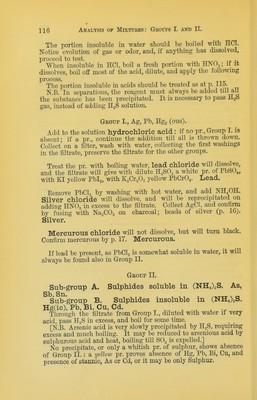
![The portion insoluble in water should be boiled with HCl. Notice evolution of gas or odor, and, if anything has dissolved, proceed to test. When insoluble in HCl, boil a fresh portion with HNOs; it it dissolves, boil off most of the acid, dilute, and apply the following process. The portion insoluble in acids should be treated as at p. 115. N.B. In separations, the reagent must always be added till all the substance has been precipitated. It is necessary to pass HaS gas, instead of adding H2S solution. Geotjp I., Ag, Pb, Hg2 (ous). Add to the solution hydrochloric acid: if no pr., Group I, is absent; if a pr., continue the addition till all is thrown down. Collect on a filter, wash with water, collecting the first washings in the filtrate, preserve the filtrate for the other groups. Treat the pr. with boiling water, lead chloride will dissolve, and the filtrate will give with dilute H2SO4 a white pr. of PbSO^, with KI yellow Pblg, with KsCr^O^ yellow PbCr04. Lead. Pemove PbCL by washing with hot water, and add NH4OH. Silver chloride will dissolve, and will be reprecipitated on adding HNO3 in excess to the filtrate. Collect AgCl, and confirm by fusing with Na^COa on charcoal; beads of silver (p. 16). Silver. Mercurous chloride will not dissolve, but will turn black. Confirm mercurous by p. 17. Mercurous. If lead be present, as PbClj is somewhat soluble in water, it will always be found also in Group II. Group II. Sub-group A. Sulphides soluble in (NH4)2S. As, Sb Sxi Sub-group B. Sulphides insoluble in (NH4)2S. Hg(ic), Pb, Bi, Cu, Cd. ^ Through the filtrate from Group I., diluted with water if very acid, pass H2S in excess, and boil for some time. [N.B. Arsenic acid is very slowly precipitated by HgS, requiring excess and much boiling. It may be reduced to arsenious acid by sulphurous acid and heat, boiling till SO2 is expelled.] No precipitate, or only a whitish pr. of sulphur, shows absence of Group II.: a yellow pr. proves absence of Hg, Pb, Bi, Cu, and presence of stannic, As or Cd, or it may be only Sulphur.](https://iiif.wellcomecollection.org/image/b21499056_0126.jp2/full/800%2C/0/default.jpg)