Notes on analytical chemistry : for students in medicine / by Albert J. Bernays.
- Albert Bernays
- Date:
- 1886
Licence: Public Domain Mark
Credit: Notes on analytical chemistry : for students in medicine / by Albert J. Bernays. Source: Wellcome Collection.
35/160 page 25
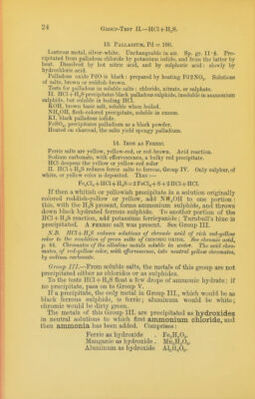
![Gkoup III.—Feuric and ALrMinrrM. 14. Iron, Ferrttm, Fe = 56. Beautiful white metal, malleable, ductile, tenacious. Sp. gr. 7 84. Rusts in damp air. Rendered passive by concentrated nitric acid, and not acted upon. Very dilute nitric acid dissolves iron as ferrous nitrate, but wheu allowed to heat. Ferric nitrate, Fe.jON03, together with water and nitroas-fumes, is formed. HCl dissolves iron lU! ferrous chloride: Fe + 2HC1 = FeCl2 + H2. Dihite sulphuric acid yields FeSO^+H.^. Chlorine attacks iron, and produces ferric chloride, FcjClg. With l2 = Fel2. Ferric oxide, FcjO^, is red-brown : an ore of iron as red haematite, reduced to metallic state by carbon at a white heat. Ferric hydrate. FeoHgOg; also native as brown haematite, 2Fe,,03,3H20. Solutions of ferric salts yellow, yellow-red, or red-brown: acid reaction. Tests for ferric salts, soluble in water. Chief salts: ferric sulphate, Fe,3SO„9H,0, and ferric chloride, Fe2Cl66H20. I. HCl brightens the yellow color. II. HCl and H^S precipitates sulphur, white or yellow, and reduces ferric to ferrous salts : Fe^Cl, + HCl + H^S = 2 FeCIa + S + 2 HCl + HCL III. NH^Cl + NH^OH, precipitates red-brown ferric hydroxide, insoluble. KOH, red-brown, FeaHeOc, insoluble. K^FeCyg. precipitates Prussian blue, Fe^FegCyigjlSHaO. KgFeCyg, a brown coloration. Potassium sulphocyauide gives blood-red solution. On charcoal, with Na-jCO„ in reducing flame, a dull-black powder attracted by the magnet. Fused with borax, in reducing flame, the bead green; in outer flame, yellowish-red. 15. Aluminum, A1 = 27. Bluish-tinted metal, malleable and ductile. Sp. gr. 2-7. Melts at 700°. Unchanged in air. Readily dissolved by dilute HCl, and H^SO,, as Al^Clg, and Alj/JSO^. with evolution of H^. Nitric acid does not attack it. Chlorine combmes with it, when heated, to aluminum chloride, Al^Cl,. The metal is made from the anhydrous chloride, by the action of sodium, and heat, A1,.0, + 3C + :iCl., = AljCl^+SCO. A]..Ci3+3Naj = Al2-f6NaCl. Aluminum oxide Al^O,, is white, and the only oxide. Salts colorless, and of acid reaction. Aluminum hydroxide, AljEgO,, is white and gelatinous: becomes oxide when heated. Na^CO;,, precipitates the hydroxide, from salts. NH^HS, precipitates the white hydroxide, and not the suljjhide. Tests for aluminum in soluble salts. Salts colorless and acid Chief salts: alum, K.,AU4sO„24H^O. Aluminum sulphate. Al23SO„18H20. Aluminum chloride, A]2Cl8,12H20. III. NH.Cl + NH.OH, a white, gelatinous precipitate of ALH^O.. insoluble. ^ ^ i 6 a, KOH, white, gelatinous hydroxide, soluble in excess as potassium alumiuate, K20,Al203,3H2O.](https://iiif.wellcomecollection.org/image/b21499056_0035.jp2/full/800%2C/0/default.jpg)