Palestine: the physical geography and natural history of the Holy Land / By John Kitto. Illustrated with one hundred and seventy-one woodcuts, by the most eminent artists.
- John Kitto
- Date:
- 1841
Licence: Public Domain Mark
Credit: Palestine: the physical geography and natural history of the Holy Land / By John Kitto. Illustrated with one hundred and seventy-one woodcuts, by the most eminent artists. Source: Wellcome Collection.
417/456 page 405
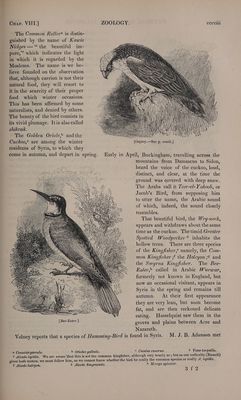
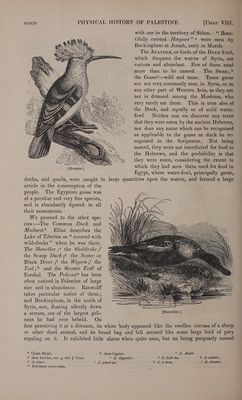
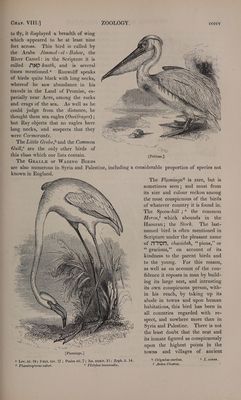
![to fly, it displayed a breadth of wing which appeared to be at least nie feet across. This bird is called by the Arabs Jimmel-el- Bahar, the River Camel: in the Scripture it is called JNP kaath, and is several times mentioned.*. Rauwolff speaks of birds quite black with long necks, whereof he saw abundance in his travels in the Land of Promise, es- pecially near Acre, among the rocks and crags of the sea. As well as he could judge from the distance, he thought them sea eagles (Osszfrages) ; but Ray objects that no eagles have long necks, and suspects that they - were Cormorants. = setts 2s The Little Grebe,” and the Common ‘Ls ga OOROR Saal Gull,” are the only other birds of PH ses 2 this class which our lists contain. [Pelican.] The GraLtuz or Wanpine Birps are also numerous in Syria and Palestine, including a considerable proportion of species not known in England. The Flamingo® is rare, but is sometimes seen; and must from its size and colour reckon among the most conspicuous of the birds of whatever country it is found in. The Spoon-bill ;° the common Heron, which abounds in the Haouran; the Stork. The last- named bird is often mentioned in Scripture under the pleasant name of FVD, chasidah, ‘ pious,” or *“‘ gracious,” on account of its kindness to the parent birds and to the young. For this reason, as well as on account of the con- fidence it reposes in man by build- ing its large nest, and intrusting its own conspicuous person, with- in his reach, by taking up its abode in towns and upon human habitations, this bird has been in all countries regarded with re- spect, and nowhere more than in Syria and Palestine. There is not the least doubt that the neat and its inmate figured as conspicuously upon the ‘highest points in the [Flamingo.] towns and villages of ancient a Ley. xi. 18; Deut. xiv. 17; Psalm eii. 7; Isa. xxxiv. 11; Zeph. ii. 14. b Colymbus auritas. e TL. canus.](https://iiif.wellcomecollection.org/image/b22013271_0417.jp2/full/800%2C/0/default.jpg)
 No text description is available for this image
 No text description is available for this image
 No text description is available for this image