Palestine: the physical geography and natural history of the Holy Land / By John Kitto. Illustrated with one hundred and seventy-one woodcuts, by the most eminent artists.
- John Kitto
- Date:
- 1841
Licence: Public Domain Mark
Credit: Palestine: the physical geography and natural history of the Holy Land / By John Kitto. Illustrated with one hundred and seventy-one woodcuts, by the most eminent artists. Source: Wellcome Collection.
423/456 page 411
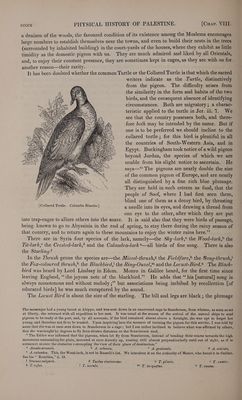
![of the body is of a flesh colour; that of the head, neck, and wings, black. The bird appears in Syria in June, about the time the white mulberries are ripe, and feeds chiefly on that fruit, when no locusts are to be found. Of this insect this bird is the most formidable enemy, and it makes its appearance about the time they may be expected. Other birds—starlings, spar- rows, swallows, feast largely upon the locusts ; but their operations seem slight, compared with the havoc committed by the Smurmur.* For this important service the bird is much respected, and its appearance hailed with gladness. There is a pretty fable that those places which are determined not to miss the services of the locust bird provide themselves with a supply of water from the country from which [not said where!] the bird comes; and that the birds scenting, in their flight, the water of their own dear land, are attracted in swarms to the neighbourhood.» Of Buntings, Syria has the Yellow Hammer ° and the Ortolan,’ which might be mistaken for it. We are not aware that in Syria the Ortolan enjoys that reputation as a table delicacy which, in a fattened state, it has acquired in the south of Europe. There is also the Black- faced Bunting.° These are all the more common Finches ; namely :— The Chaffinch,‘ the Goldfinch,® the Red Linnet,® the Sparrow.i This last impertinent cosmopolite is in prodigious numbers ; sparrows swarm in the towns, and sometimes visit the houses, and build their nests about them to such an extent as to become a serious annoyance. Of the multitudinous genus Muscicapide or Fly-catchers, only one species, the Pied Fly- catcher* has beenparticularly noticed in Syria. Of the still more extensive genus of Wagtails or Warblers, Palestine offers an interesting collection ; but none of them occur with much frequency. Most readers will remember that there is little allusion in Scripture to the singing of birds; and we used to think that the almost perfect silence of the Hebrew poets respecting the songs of birds, which supply so many beau- tiful allusions in the poetry of western nations, might be understood to imply that song-birds were scarce in Palestine. And this, now at least, proves to be the fact. There are a few favourite localities which the song-birds frequent, and where their sweet voices are heard. But, speaking generally, Paxton says :—“‘ The singing of birds is not often heard in Palestine. There are a few species of birds, with a gaudy plumage, but their notes are not melodious. ‘The sweet plaintive note of the nightingale is sometimes heard, but oftener the harsh cawing of the crow.” The Mightingale,' thus introduced to our notice, is heard during the greater part of the garden season, singing delightfully in the daytime from amid the pomegranate groves, and from trees of loftier growth in the night-season. In the larger towns there are persons who keep night- ingales in cages, and let them out, at a small rate, to nocturnal assemblies; so that most entertainments of ceremony during the sprmg have a concert of nightingales. This might seem an incongruous employment of a bird so proverbially ‘* mournful ;”’ but those who know him will say he is— ‘* The merry nightingale That crowds, and hurries, and precipitates, With fast thick warble, his delicious notes, As he were fearful that an April night Would be too short for him to utter forth His love-chant, and disburthen his full soul Of all its music.’””—CoLERIDGE. After the nightingale comes the Petty-Chaps,™ the White Water-Wagtail” the Win-Chat,° the Robin Redbreast,? and the Wren.4 a The native name, framed like a large number of the Arabic names of birds, in imitation of the note or sound which the bird gives forth. b “ Mémoires des Missions,”’ viii. 113. y © Emberiza hortulana. dE. citrinella, e KE. quelea. f Fringilla celebs. & F. carduelia. h R, linaria. i E. domestica. k Muscicapa atricapella. 1 Motacilla luscinia. m M. ficedula, n M, alba.. ° M. ruberta. P M. rubicula. 4 M. troglodytis. 3¢2](https://iiif.wellcomecollection.org/image/b22013271_0423.jp2/full/800%2C/0/default.jpg)
 No text description is available for this image
 No text description is available for this image
 No text description is available for this image