Noise from motor vehicles : interim report / Committee on the Problem of Noise.
- Great Britain. Committee on the Problem of Noise
- Date:
- [1962]
Licence: Public Domain Mark
Credit: Noise from motor vehicles : interim report / Committee on the Problem of Noise. Source: Wellcome Collection.
15/54 page 9
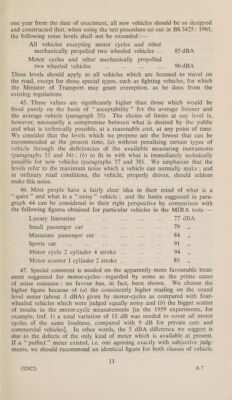
![Cycle and Motor Cycle Industries Association Ltd., which satisfied us that there are no technical objections to the introduction of noise limits at reasonable levels and that the accelerating vehicle test proposed by the ISO would be generally acceptable. 37. The Society’s evidence was that a maximum limit of 85 dBA under the conditions of this test was the lowest that would be practicable fior diesel engined commercial vehicles at the present time. The reason for this is that the level of mechanical noise caused by the engines of these vehicles, as distinct from exhaust noise, was little below this figure, so that further reduction of exhaust noise would have no appreciable effect on the total noise level, and the predominant noise would then become that of the engine. Comparatively little is known about the reduction of engine noise; indeed, the sources of predominant noise in diese] engines have not been fully established, and to effect any substantial reduction might involve a revolution in engine design, which might take some years to achieve. At present most private cars emit noise of less than 85 dBA under the conditions of the test. In the Society’s view, manufacturers of sports cars would suffer the greatest penalties if noise limits of this order were introduced, because their policy was to give greater importance than saloon car manufacturers to achieving the maximum possible power. 38. The Association’s evidence was that for motor cycles a limit of 90 dBA was the lowest that could be achieved at present, and even this figure would be particularly difficult to achieve in the case of the four- stroke twin cylinder machine. Any limit substantially lower would be impossible for these machines and could only be achieved for other four- stroke machines at considerable cost and with substantial loss of perform- ance. A lower limit might be practicable for two-stroke machines. The Association emphasized the importance of the large capacity machine in the industry’s exports. They said that to achieve a substantially lower level than 90 dBA for these machines would involve modifying the engines as well as the silencers. Cost 39. On the question of the true cost of achieving a noise limit at any given level (c) of paragraph 26, we found it beyond our competence to obtain really positive evidence. The view of manufacturers of motor vehicles is already implied in paragraphs 37 and 38; we were not able to obtain specific figures, for example for high-performance sports cars, on the relation between, say, 5 dBA reduction in exhaust noise, and the increase in cost and diminution in performance. The value of sports cars exported in 1960 was over £30,000,000; and of motor cycles of over 250 c.c. engine capacity, £3,700,000. It is indeed difficult to estimate what fraction of this might be lost by the need for alternative designs or special fittings. ‘The cost (e.g. in purchase price) to the vehicle owner in this country, if our recommendations are adopted, is not in our view likely to be serious for the large majority of vehicles; but, of course, if the limits we are suggesting were to be considerably reduced, this cost might rise very steeply and indeed prohibitively, to the point when most diesel engined vehicles, sports cars and motor-cycles were, in effect, banned from the roads. A further item of cost to bear in mind is that of admunis- tration and enforcement of noise limits; we have sought no evidence on this point. z](https://iiif.wellcomecollection.org/image/b3217908x_0015.jp2/full/800%2C/0/default.jpg)
 No text description is available for this image
 No text description is available for this image
 No text description is available for this image