Noise from motor vehicles : interim report / Committee on the Problem of Noise.
- Great Britain. Committee on the Problem of Noise
- Date:
- [1962]
Licence: Public Domain Mark
Credit: Noise from motor vehicles : interim report / Committee on the Problem of Noise. Source: Wellcome Collection.
17/54 page 11
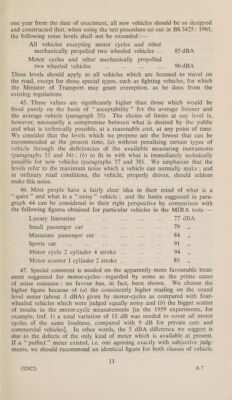
![one year from the date of enactment, all new vehicles should be so designed and constructed that, when using the test procedure set out in BS 3425: 1961, the following noise levels shall not be exceeded : — All vehicles excepting motor cycles and other mechanically propelled two wheeled vehicles ... 85 dBA Motor cycles and other mechanically eg two wheeled vehicles a a + i 90 dBA These levels should apply to all vehicles cece are licensed to travel on the road, except for those special types, such as fighting vehicles, for which the Minister of Transport may grant exemption, as he does from the existing regulations. 45. These values are significantly higher than those which would be fixed purely on the basis of “acceptability” for the average listener and the average vehicle (paragraph 35). The choice of limits at any level is, however, necessarily a compromise between what is desired by the public and what is technically possible, at a reasonable cost, at any point of time. We consider that the levels which we propose are the lowest that can be recommended at the present time, (a) without penalising certain types of vehicle through the deficiencies of the available measuring instruments (paragraphs 33 and 34); (5) to fit in with what is immediately technically possible for new vehicles (paragraphs 37 and 38). We emphasize that the levels refer to the maximum noise which a vehicle can normally make ; and in ordinary road conditions, the vehicle, properly driven, should seldom make this noise. 46. Most people have a fairly clear idea in their mind of what is a “ quiet’ and what is a “noisy” vehicle; and the limits suggested in para- graph 44 can be considered in their right perspective by comparison with the following figures obtained for particular vehicles in the MIRA tests : — Luxury limousine _... gs nah me a 77 dBA Small passenger car re Ae ‘as Be BOLE Miniature passenger car... ok is AG Saw 55 Sports “car ee, ee it oe OA aise Motor cycle 2 sori. 4 ca Ra 1 an SAU Motor scooter 1 cylinder 2 stroke ... ne oe SU: 47. Special comment is needed on the apparently more favourable treat- ment suggested for motor-cycles—regarded by some as the prime cause of noise nuisance; no favour has, in fact, been shown. We choose the higher figure because of (a) the consistently higher reading on the sound level meter (about 3 dBA) given by motor-cycles as compared with four- wheeled vehicles which were judged equally noisy and (b) the bigger scatter of results in the motor-cycle measurements [in the 1959 experiments, for example, (ref. 1) a total variation of 15 dB was needed to cover all motor cycles of the same loudness, compared with 9 dB for private cars and commercial vehicles]. In other words, the 5 dBA difference we suggest is due to the defects of the only kind of meter which is available at present. If a “ perfect” meter existed, ic. one agreeing exactly with subjective judg- ments, we should recommend an identical figure for both classes of vehicle. il](https://iiif.wellcomecollection.org/image/b3217908x_0017.jp2/full/800%2C/0/default.jpg)