Noise from motor vehicles : interim report / Committee on the Problem of Noise.
- Great Britain. Committee on the Problem of Noise
- Date:
- [1962]
Licence: Public Domain Mark
Credit: Noise from motor vehicles : interim report / Committee on the Problem of Noise. Source: Wellcome Collection.
49/54 page 41
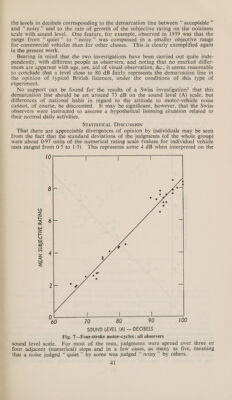
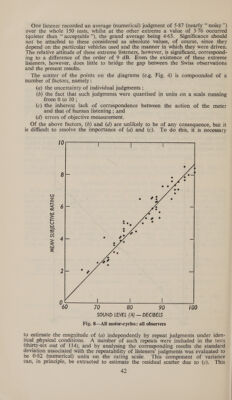
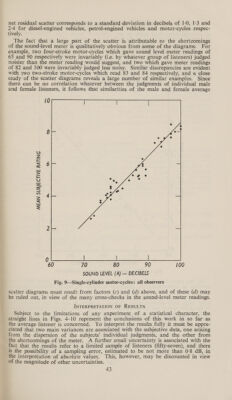
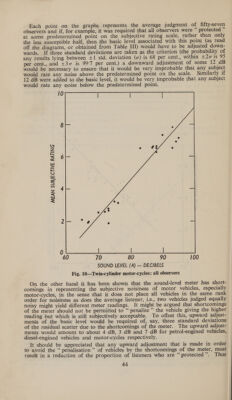
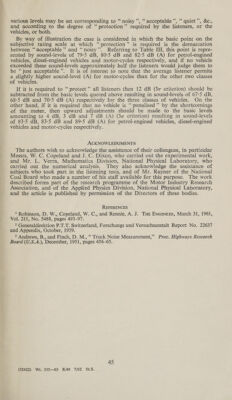
![and “noisy” and ito the rate of growth of the subjective rating on the noisiness scale with sound level. One feature, for example, observed in 1959 was that the range from “quiet” to ‘“inmoisy’’ was compassed in a smaller objective range for commercial vehicles than for other classes. This is clearly exemplified again in the present work. Bearing in mind that the two investigations have been carried out quite inde- pendently, with different people as observers, and noting that no marked differ- ences are apparent with age, sex, aid of visual observation, &c., it seems reasonable to conclude that a level close to 80 dB fairly represents the demarcation line in the opinion of typical British listeners, under the conditions of this type of exiperiment. No support can be found for the results of a Swiss investigation? that this demarcation line should be set around 73 dB on the sound level (A) scale, but differences of national habit in regard to the attitude to mottor-vehicle noise cannot, of course, be discounted. It may be significant, however, that the Swiss observers were instructed to assume a hypothetical listening situation related to their normal daily activities. STATISTICAL DISCUSSION That there are appreciable divergences of opinion by individuals may be seen from the fact that the standard deviations of the judgments (of the whole group) were about 0-97 units of the numerical rating scale (values for individual vehicle tests ranged from 0-5 to 1:3). This represents some 4 dB when interpreted on the 10 MEAN SUBJECTIVE RATING 60 70 80 90 100 SOUND LEVEL (A) — DECIBELS Fig. 7—Four-stroke motor-cycles: all observers sound Jevel scale. For most of the tests, judgments were spread over three or four adjacent (numerical) steps and in a few cases, as many as five, meaning that a noise judged “quiet” by some was judged “noisy” by others. 4]](https://iiif.wellcomecollection.org/image/b3217908x_0049.jp2/full/800%2C/0/default.jpg)