Epidemiological Society, for the Investigation of Epidemic Diseases.
- Epidemiological Society of London
- Date:
- [1852]
Licence: Public Domain Mark
Credit: Epidemiological Society, for the Investigation of Epidemic Diseases. Source: Wellcome Collection.
Provider: This material has been provided by The Royal College of Surgeons of England. The original may be consulted at The Royal College of Surgeons of England.
2/24 page 2
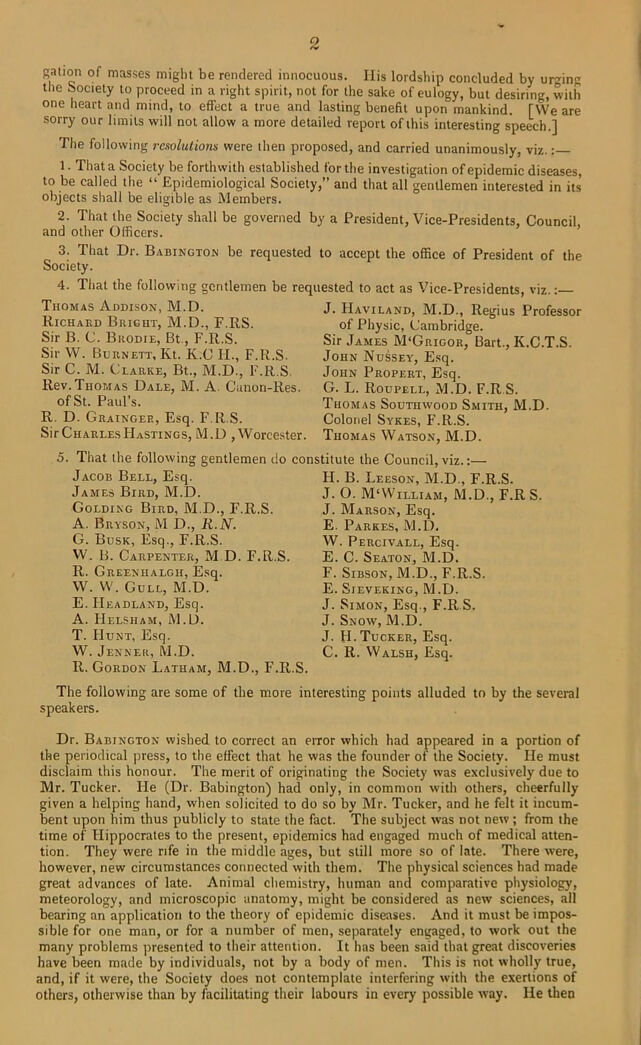
![gallon of masses might be rendered innocuous. His lordship concluded by ur'^ing the Society to proceed in a right spirit, not for the sake of eulogy, but desiring, with one heart and mind, to effect a true and lasting benefit upon mankind. [We are sorry our limits will not allow a more detailed report of this interesting speech.] The following resolutions were then proposed, and carried unanimously, viz.: 1. That a Society be forthwith established for the investigation of epidemic diseases, to be called the “ Epidemiological Society,” and that all gentlemen interested in its objects shall be eligible as Members. 2. That the Society shall be governed by a President, Vice-Presidents, Council, and other Officers. 3. That Dr. Babington be requested to accept the office of President of the Society. 4. Tliat the following gentlemen be requested to act as Vice-Presidents, viz. Thomas Addison, M.D. Richard Bright, M.D., F.RS. Sir B. C. Brodie, Bt., F.R.S. Sir W. Burnett, Kt. K.C H., F.R.S. Sir C. M. Clarke, Bt., M.D., F.R.S, Rev.Thomas Dale, M. A. Canon-Res. of St. Paul’s. R. D. Grainger, Esq. F.R.S. Sir Charles Hastings, M.D , Worcester. J. Haviland, M.D., Regius Professor of Physic, Cambridge. Sir James M'Grigor, Bart., K.C.T.S. John Nussey, E.sq. John Propert, Esq. G. L. Roupell, M.D. F.R.S. Thomas Southwood Smith, M.D. Colonel Sykes, F.R.S. Thomas Watson, M.D. 5. That the following gentlemen do constitute the Council, viz.:— Jacob Bell, Esq. James Bird, M.D. Golding Bird, M.D., F.R.S. A. Bryson, M D., R.N. G. Busk, Esq., F.R.S. W. B. Carpenter, M.D. F.R.S. R. Greenhalgh, Esq. W. W. Gull, M.D. E. Headland, Esq. A. Helsham, M.D. T. Hunt, Esq. W. Jenneii, M.D. R. Gordon Latham, M.D., F.R.S H. B. Leeson, M.D., F.R.S. J. O. M‘William, M.D., F.R S. J. Marson, Esq. E. Parkes, M.D. W. Percivall, Esq. E. C. Seaton, M.D. F. SiBSON, M.D., F.R.S. E. SlEVEKING, M.D. J. Simon, Esq., F.R.S. J. Snow, M.D. J. H.Tucker, Esq. C. R. Walsh, Esq. The following are some of the more interesting points alluded to by the several speakers. Dr. Babincton wished to correct an error which had appeared in a portion of the periodical press, to the effect that he was the founder of the Society. He must disclaim this honour. The merit of originating the Society was exclusively due to Mr. Tucker. He (Dr. Babington) had only, in common with others, cheerfully given a helping hand, when solicited to do so by Mr. Tucker, and he felt it incum- bent upon him thus publicly to state the fact. The subject was not new; from the time of Hippocrates to the present, epidemics had engaged much of medical atten- tion. They were rife in the middle ages, but still more so of late. There were, however, new circumstances connected with them. The physical sciences had made great advances of late. Animal chemistry, human and comparative physiology, meteorology, and microscopic anatomy, might be considered as new sciences, all bearing an application to the theory of epidemic diseases. And it must be impos- sible for one man, or for a number of men, separately engaged, to work out the many problems presented to their attention. It has been said that great discoveries have been made by individuals, not by a body of men. This is not wholly true, and, if it were, the Society does not contemplate interfering with the exertions of others, otherwise than by facilitating their labours in every possible way. He then](https://iiif.wellcomecollection.org/image/b22337453_0004.jp2/full/800%2C/0/default.jpg)