On mycetoma, or the fungus disease of India / by H. Vandyke Carter.
- Henry Vandyke Carter
- Date:
- 1874
Licence: Public Domain Mark
Credit: On mycetoma, or the fungus disease of India / by H. Vandyke Carter. Source: Wellcome Collection.
Provider: This material has been provided by The Royal College of Surgeons of England. The original may be consulted at The Royal College of Surgeons of England.
164/172
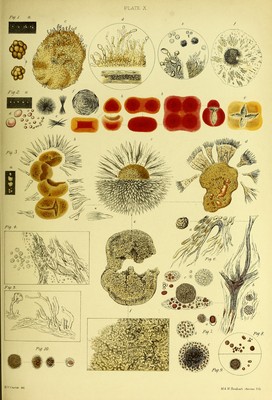
![Illustrations of the niimite structure of the fungus-particles {^[^llacol■ia), belonging to the ])ale [OcJtro'ul) variety of Mycetoma. Fig. 1.—The true fungus-elements found in the case of the woman described at page 8; for description see page 73. a. Natural size of the particles. b. Particles as seen magnified hy aid of a lens; their normal colour, and their tuberculated exterior are here shown. c. An entire smaller pai’ticle, as seen with ^-inch objective. Its true cellular character is apparent. d. Free surface of the same, as seen under a higher power (X 250 diameters). The luxuriant growth and multiplication of the component cells is clearly seen; no other structiu’es but these exist. Some of the beaded filaments have a dilated extremity, but sporangia had not formed; nor were conidia seen to be detached. At the lower part of the circle is shown the structure of the filaments desci'ibed in the text, at page 73, as being ju’esent in the gelatinous matrix holding the fungus-particles, in the foot. The relation of these filaments to the particles was not made out. e. Contents of the fluid discharged from openings in the foot. Besides pus-cells, blood-corpuscles, and gi-anule- raasses, there were seen the small collections of fungus-growth shown in the figure. Sometimes the beaded fibres were large and distinct; at others, smaller filaments were seen, shown to the right and below. X 300 diameters. /. One of some particles, occasionally detected. They were opaque in parts corresponding to the nucleus or centre, and to certain rays passing oft’ in a radiating manner. It seemed to me that the dark globular centi’e corre- sponded to the body of an ordinary malacotnim; whilst the incipient rays would form its crystalline envelope; and that there was here a transition from these distinctly cellular bodies, to the more obscure ones, which are commonly found. Fig. 2.—The pink particles found in the specimen from Madura, See page 9. a. Natural size and appearance of the particles. . h h. Particles as seen with a power of 200 diameters. Their varying size, form, and construction are here shown. For description, see page 74. c. A particle of difl'erent colour. It had burst open in the manner shown; and the fincly-granular interior was then seen ; the same appearance was present in other specimens. d. Globules of oil, of varying sizes ; they partake of the pink hue, and give rise to the general tint. c. Collections of fat-crystals. /. A globe epiderniigue found amongst the pink jiarticles; there were, besides, several masses of epithelial scales, of great delicacy. Fig. 3.—Fungus-particles (malacotia) of the kind commonly met with. For full descriptions, see page 74. o. Natural size and appearance of these bodies. b. A small collection of them, still in apposition, and retaining part of their crystalline fringe. The larger, compact aggregations, which have been compared to the ‘ ova of fishes,’ to ‘ poppy-seeds,’ &c., have a similar general aii’angement of the particles and fringes. Taken from a perfectly fresh specimen just removed from the foot. X 200 diameters. c. An ideal particle, but founded on fact. In the centre is the essential element—the malacotium—of globular foiTU and tinted hue; and surrounding it, on all sides, is the crystalline envelope, which is regarded as being composed of the more solid fat-principles. At * is one of these fatty coi’puscles of a complicated character. d. One of the particles taken from the Bhooj specimen, described at page 9, and here represented as showing certain peculiai-ities. The interior of the compressed mass is seen to contain several ovoid bodies, which had a certain resemblance to spores, or secondary cells, but which were, probably, globules of oil; and the crystalline envelope was here of more complicated constiniction than usual. X 250 diameters. See page 7G. e. The appearance of a ‘ malacotium,’ as viewed with a power of 700 diameters. The specimen had been preserved in dilute alcohol. /. A portion of the same, more highly magnified. Fig. 4.—Structure of the membrane investing the black particles and lining the canals; as seen in the specimen from Bhooj, described at page 4. There are—1, a fibrillated structure; 2, myriads of cells or nuclei; 3, tubes filled with cells or nuclei; but these latter are not shown in the original figure. Fig. 5.—Stnictures found adherent to, or imbedded in the above membrane. It would seem as if the growth of a mycelium had commenced in this instance; see page 70. X 200 diameters. Fig. 6.—The structure and arrangement of the ‘ pink stains,’ which are supposed to indicate an incipient stage of growth of the fungus-particles. See page 78. a. From the skin of the said specimen (melanoid variety, Case 3, page 4). The appearance is as if some natural tubes or ducts had become filled with coloured granules ; an isolated, spheroidal group is seen, the individual particles forming which had a diameter of — lioVo b. Other pink stains in the skin. Collections of coloured granules are seen, which are probably ‘zooglaa-forms’ appertaining to the early stage of the parasitic growth. c. From the same foot. Here are various structures, described in the text, which seem to indicate stages in the development of the fungus-particles. Fig. 7.—Other like stnictures from a specimen of the Ochroid variety of Mycetoma; that, namely, from Bhooj. See page 80. a. Bodies found free, in a section made near the toes. b. Another ‘ zoogloea-mass ’ from the same part. c. A still larger similar collection. Fig. 8.—Bodies seen in the substance of the skin, in a perfectly fresh specimen of the pale variety of Mycetoma, (Case 4, page 10) acetic acid -(- glycerine. Some of them were seen in close contact with the sweat-ducts, but not, to all appearance, within them. They were an-anged in streaks, not unlike those seen elsewhere. Fig. 9.—Bodies taken from the same specimen; they were found alongside a tendon, in its sheath. Fig. 10.—Structures seen near the aperture of a canal (Bhooj specimen, second variety). They seem to indicate the mode of origin of the soft, pale particles; commencing at the right hand and proceeding towards the left, the gradual transition of forms may be seen, which intervene between bodies like those found in the skin, and the mature malacotium.](https://iiif.wellcomecollection.org/image/b22372635_0166.jp2/full/800%2C/0/default.jpg)