On the anomalies on accommodation and refraction of the eye : with a preliminary essay on physiological dioptrics / by F. C. Donders ; translated from the author's manuscript by William Daniel Moore.
- Franciscus Donders
- Date:
- 1864
Licence: Public Domain Mark
Credit: On the anomalies on accommodation and refraction of the eye : with a preliminary essay on physiological dioptrics / by F. C. Donders ; translated from the author's manuscript by William Daniel Moore. Source: Wellcome Collection.
Provider: This material has been provided by UCL Library Services. The original may be consulted at UCL (University College London)
11/304
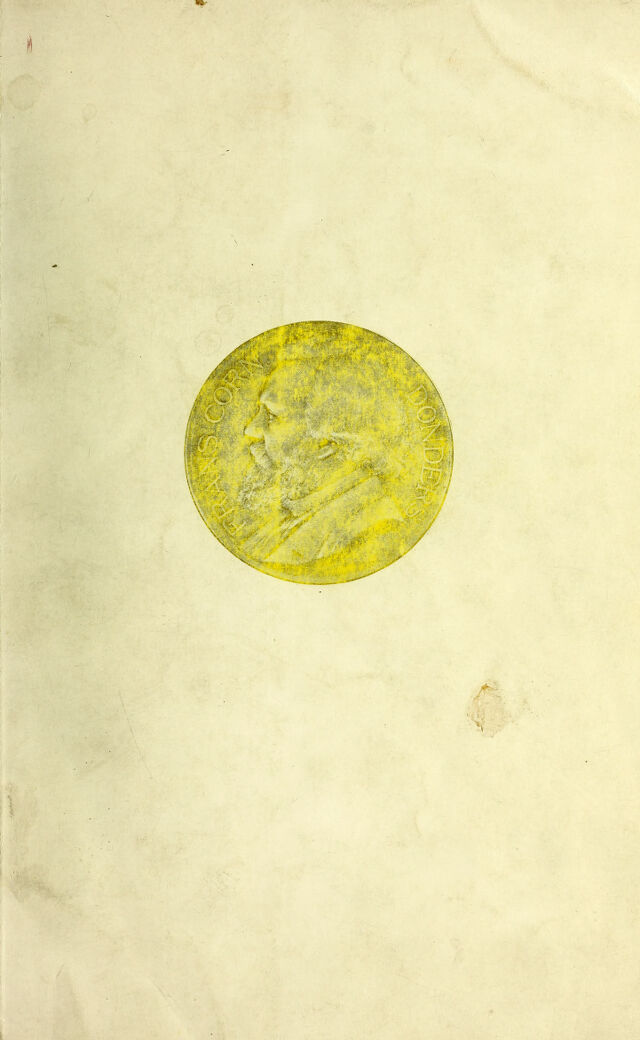
![FRANCISCUS CORNELIS DONDERS AND HIS TIME The importance of Donders can only be fully understood if he is seen against the background of the period in which he lived. What he gave to suffering mankind by his scientific work is now so much taken for granted that we do not usually pause to consider the days without this knowledge, a time when such knowledge was brand-new and like a revelation. Let me endeavour to sketch the period in which Donders lived. Natural philosophy had flourished in the preceding century. The nineteenth century promised to be the age of natural history. Jordan1 says on this subject: 'There was a time when biology saw its sole task in the classification of physical forms. Linnaeus (1707-1778) created a system which allows animals and plants to be classified as a good librarian will arrange all books: whatever the contents of a book may be, it has its natural place in the library. When it is in its proper place it can always be located. To Linnaeus, zoologists were only those men who occupied them- selves with such classification. Those who occupied themselves with the organization itself were no more than zoophili. This view, which would be inconceivable nowadays, was by no means incorrect at the time. The system had to be created; for it is not possible to order the sum of our knowledge into a science if we have no scheme for classifying the various organisms. Linnaeus' concept of species in animals and plants was absolutely rigid. The species had been created and were preserved as such. Similarly, Darwin's and Haeckel's evolution theories were from the first influenced by the systematization of animals and plants. The theory of evolution made an imaginary relationship into common descent. If we know the genetic relation between various organisms, i.e. their ancestry, then we know their natural order. Only in the sec- ond place did the theory of evolution attempt to give a scientific explanation of the causality of life. Human effort will always outgrow its original intention. Darwin's theory assumes variability, which will produce hereditary modifica- tions, and natural selection, i.e. survival of the fittest and extinction of individuals less suited to the struggle for existence. There is no question of any purpose here. The varieties themselves are not evolved in accordance with any plan, but causally, that is, as a result of causes which are totally unrelated to the usefulness of the variety. Only the struggle for life would turn this suitability of the new elements of the organization to the demands made by prevailing conditions into the characteristics of a new species'. 1H. J. Jordan, De causale verklaring van het leven (The causa] explanation of life), Amsterdam, 1941.](https://iiif.wellcomecollection.org/image/b21284842_0011.jp2/full/800%2C/0/default.jpg)