Licence: Public Domain Mark
Credit: Ornithological dictionary of British birds / By G. Montagu. Source: Wellcome Collection.
46/666
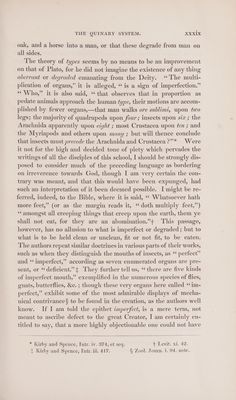
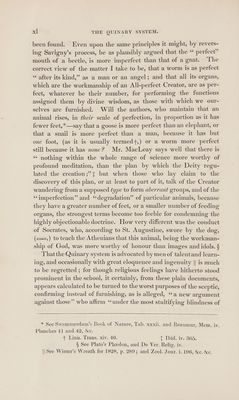
![ciples, being evidently a shoot from Plato’s wild theory of pre- existant ideas, or the archetypes of all things, * and more directly borrowed from the atheistic system of Robinet. His doctrine bears, that Nature’s grand aim was to make man, and being inca- pable of doing so at once, undertook an apprenticeship (appren- tisage) of experiments, by making various types of his several organs; such as the hand-shaped roots of some of the orchis fa- mily, the brain-stone coral, and the stink horn, (Phallus fetidus, Sowerrsy,) of many of which he gives figures. ‘ A stone,” he says, “‘ an oak, a horse, a monkey, a man, are only graduated va- riations of a prototype which has begun to be realized by the least possible elements. A stone, an oak, a horse, are not men, but they can be regarded as types, more or less conformable to the same primitive design, and they are all the product of the same idea, more or less developed.”+ It was with no little astonish- ment, that I found the Rev. W. Kirby, a naturalist of great talent, an accomplished scholar, and a divine of the soundest religious sentiments, for whose works I have a high esteem, not only adopting, but eulogizing this very doctrine, as coming from Mr. Macleay, though he elsewhere rejects it with laud~ able indignation, as coming from Robinet.{ ‘ According,” he says, “to this opinion,” [MacLeay’s] ‘which seems the most consistent of any yet advanced, and which reconciles facts which upon no other plan can be reconciled, the series of beings is involved in the highest degree, rolling wheel within wheel ad infinitum, and revolving, if I may so speak, round its centre and summit—man :§ who, though not including in himself all that distinguishes them, is still the great type in which they terminate, and from which they degrade on all sides.” || ‘This, indeed, seems almost a translation of Robinet. I am not surely called upon to enter into a serious refutation of such doctrines as these, or to be accused of dealing in unproved assertion, by appealing for their fallacy to the plain sense of the reader. On the contrary, I am most justly entitled to call for a proof of the assumptions, that a stone has improved itself into an * Cicero, Tusc. Quest. I. 15. + Robinet, De la Nature, v. vii. } Intr. iii. 350, note. _§ “ N. Dict. d’Hist. Nat. xx. 485.” || Intr. iv. 369.](https://iiif.wellcomecollection.org/image/b33488484_0046.jp2/full/800%2C/0/default.jpg)
 No text description is available for this image
 No text description is available for this image
 No text description is available for this image