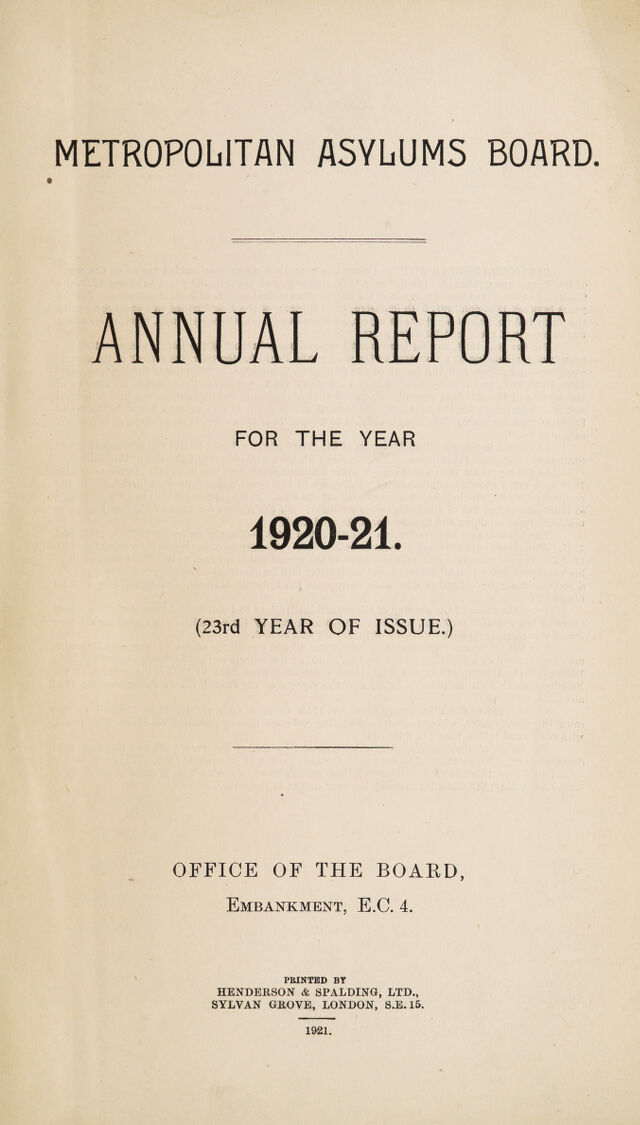
Annual report for the year 1920-21 : (23rd year of issue) / Metropolitan Asylums Board.
- Metropolitan Asylums Board (London, England)
- Date:
- 1921
Licence: In copyright
Credit: Annual report for the year 1920-21 : (23rd year of issue) / Metropolitan Asylums Board. Source: Wellcome Collection.
38/182
![By Order dated 18 February, 1911, the Local Government Board sanctioned the admission to any of the infectious hospitals of poor persons suffering from such infectious or contagious diseases other than those above mentioned as they might thereafter determine. On 22 February, 1912, the Board sanctioned the admission of poor children suffering from measles or whooping cough received through the metropolitan poor law authorities, while by further Orders, dated 30 May, 1911, and 9 August, 1912, issued pursuant to the provisions of the Public Health (London) Act, 1891, sec. 80, the Local Government Board sanctioned the admission, subject to certain restrictions, of non-pauper cases of measles and whooping cough respectively. On 2 July, 1912, the Local Government Board (under their Order of 18 February, 1911) authorised the Board to receive into .heir infectious hospitals, through the poor law authorities, poor persons suffering from puer¬ peral fever, and by Order dated 20 August, 1912, prescribed that, subject to certain restrictions, non-pauper cases should also be admitted. Provision is made at the infectious hospitals for the instruction of medical students and of candidates for the diploma of public health. Provision is also made for bacteriological work and for research work into the causation of infectious disease. The Board receives from the several medical officers of health notifications of infectious disease occurring in the metropolis, and publishes information relating thereto. [Infectious Disease (Notification) Act, 1889 (52 & 53 Vic., c. 72), and Public Health (London) Act, 1891 (54 & 55 Vic., c. 76), s. 55, s.s. (4).] (ii.) Institutions for tuberculous patients. The Board has entered into arrangements with the London County Council under which it provides residential treatment for tuberculous patients in the county of London [National Insurance Acts, 1911 to 1918, 1 & 2 Geo. 5, c. 55, and 3 & 4 Geo. 5, c. 37, and 7 & 8 Geo. 5, c. Public Health (Pr vention and Treatment < f Diseases) Act, 1913, 3 & 4 Geo. 5, c. 23]. Under the National Health Insurance Act, 1920, sanatorium benefit will cease to be included among the benefits conferred by Part I. of the Act of 1911. The Ministry of Health have fixed 1 May, 1921, for sanatorium benefit to cease as an insurance benefit, the cost being borne partly by the Government and partly by the Board. (in.) Ambulance service. By the Poor Law Act, 1879 [42 & 43 Vic., c. 54, s. 16], superseded by sec. 79 of the Public Health (London) Act, 1891, the Board was empowered to provide an ambulance service for the removal of patients. (iv.) The mentally defective. The Local Government Board Order, dated 15 May, 1867, included the “ insane ” amongst the classes of poor for whose reception and relief the Board was constituted. A further Order, dated 18 May, 1875, defined the persons to be admitted into the Board’s mental hospitals as such harmless persons of the chronic or imbecile class as could be lawfully retained in a workhouse; but no dangerous or curable persons such as would under the statutes in that behalf require to be sent to a lunatic asylum shall be admitted. A Local Government Board Order, dated 2 April, 1897, included feeble-minded children amongst the classes of poor persons to be received by the Board, and authority was subsequently given for the retention of these](https://iiif.wellcomecollection.org/image/b3030040x_0038.jp2/full/800%2C/0/default.jpg)


 No text description is available for this image
 No text description is available for this image
 No text description is available for this image