Cyclopaedia of the diseases of children, medical and surgical / The articles written especially for the work by American, British, and Canadian authors. Ed. by John M. Keating.
- John Marie Keating
- Date:
- [1889-99]
Licence: Public Domain Mark
Credit: Cyclopaedia of the diseases of children, medical and surgical / The articles written especially for the work by American, British, and Canadian authors. Ed. by John M. Keating. Source: Wellcome Collection.
Provider: This material has been provided by the Harvey Cushing/John Hay Whitney Medical Library at Yale University, through the Medical Heritage Library. The original may be consulted at the Harvey Cushing/John Hay Whitney Medical Library at Yale University.
930/1148 (page 858)
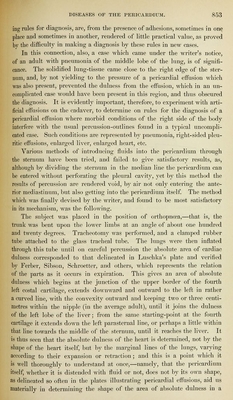
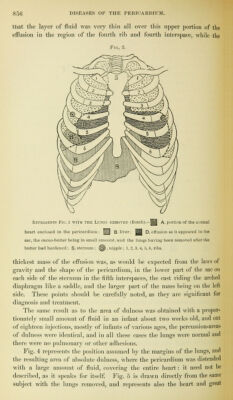
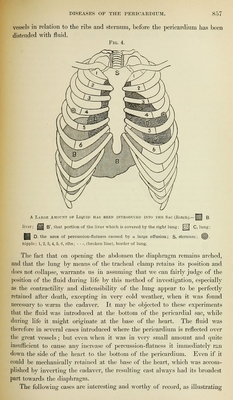
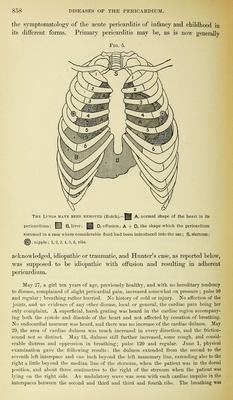
![the symptomatology of the acute pericarditis of infancy and childhood in its different forms. Primary pericarditis may be, as is now generally Fig. 5. The Li'NGS have been removed (Rotch).—^H A, normal shape of the heart in its pericardium ; j]||| B, liver; ^| D, effusion; A + D, the shape which the pericardium assumed in a case where considerable fluid had been introduced into the sac; S, sternum; (^ , nipple; 1, 2, 3, i, 5, 6, ribs. acknowledged, idiopathic or traumatic, and Hunter's case, as reported below, was supposed to be idiopathic with efCusion and resulting in adherent pericardium. May 27, a girl ten j'ears of age, previously healthy, and with no hereditary tendency to disease, complained of slight pericardial pain, increased somewhat on pressure; pulse 90 and regular ; breathing rather hurried. No history of cold or injury. No affection of the joints, and no evidence of any other di.sease, local or general, the cardiac pain being her only complaint. A superficial, harsh grating was heard in the cardiac region accompany- ing both the systole and diastole of the heart and not affected by cessation of breathing. No endocardial murmur was heard, and there was no increase of the cardiac dulness. May 29, the area of cardiac dulness was much increased in every direction, and the friction- sound not so distinct. May 31, dulness still further increased, some cough, and consid- erable distress and oppression in breathing; pulse 120 and regular. June 1, physical examination gave the following results: the dulne.ss extended from the second to the seventh left interspace and one inch beyond the left mammary line, extending also to the right a little bej'ond the median line of the sternum, when the patient was in the dorsal position, and about three centimetres to the right of the sternum when the patient was lying on the right side. An undulatory wave was seen with each cardiac impulse in the interspaces between the second and third and third and fourth ribs. The breathing wa«](https://iiif.wellcomecollection.org/image/b2101811x_0930.jp2/full/800%2C/0/default.jpg)