Copy 1, Volume 1
A dictionary of the Welsh language, explained in English. With numerous illustrations, from the literary remains and from the living speech of the Cymry / [W. Owen Pughe].
- William Owen Pughe
- Date:
- 1803
Licence: Public Domain Mark
Credit: A dictionary of the Welsh language, explained in English. With numerous illustrations, from the literary remains and from the living speech of the Cymry / [W. Owen Pughe]. Source: Wellcome Collection.
727/790 page 707
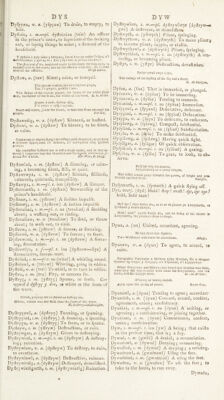
![DYS Dyfpyxu, •v. a. (yfpyzu) To drain, to empty, to bale. Dyftain, s. m.—pL dyfteiniau (tain) An officer in the prince’s court, to fuperintend the decking out, or laying things in order j a fteward of the houfehold. y dyftain a zyly ranu y llettyauj iio ei hun yn nefav i’r llys, a’r fcoil fwyzwyr y gyd ag ev ; Eve y lyz ben ar yr holi iwyzwyr. The Jicxcard of the boujehold ought todiiiribute the lodgings; to himlelfnext to the court, anu ail the officers with him . He is head overall the officers, Lazvs. Dyftaw, a. (taw) Silent j calm, or tranquil. Tad planad waftad, tad niwl dyllaw gwyn, Tad i’r gwynt, gwaith i law. The father of the regular planet, the father of the white fiknt atilt, die father of the wind, the works or his hand, i. 0, Coibi- Angeu a zaw, dyftaw don, I’w zwyn o vyfg i zynion. Death will come, f 'lLent the found, to take him from amongft hii people, JoloGo(j, Dyftawedig, v. a. (dyftaw) Silenced, or huftied. Dyftewi, ‘u, a. (dyftaw) To fiiencej to be filent, or calm. Gadawoez vy nhywyfawg i mi orfwys peth dragevyn; ac yn hyn.y « feibiant dygwyzoez i’r taranau, a’r corw'yntoz cro5 zyltewi tionyn. My conduftor fuffered me to reft a while again; and in that in¬ terval it happened that the thunde.rs and the l^arle whirlwinds//- lenccd for a httle. Mis B. Cwji. Dyftawlad, s. m. (dyftaw) A fflencing, or calm¬ ing, a becoming filent, ftill, or quiet. Dyftawrwyz, s. m- (dyftaw) Silence, ftillnefs, calmnefs, quietnefs, tranquillity, Dyftawyz, s. w.—pi. t. ion (dyftaw) A fflencer. Dyfteiniaeth, s. m. (dyftain) Stewardihip of the prince’s houfehold. Dyftraw, s, m. (yftraw) A fudden impulfe, Dyftrawj, s. m. (dyftraw) A fudden impulfe. Dyftreuliad, s. m.—pL t. au (treuliad) A fhedding about5 a waffling out, or rinffng. Dyftreuliaw, v. a. (treuliaw) To fhed, or throw about; to wafh out, to rinfe. Dyftrew, 5, m. (yftrew) A fneeze, or fneezing. Dyftrewi, n). a. (dyftrew) To fneeze; to fnort. Dyftrewiad, i. m.—pi. t. au (dyftrew) A fneez¬ ing, fternutation. Dyftrewlys, s. f.—pi. t. iau (dyftrew—Hys) A fternutative, Iheeze-wort. Dyftroad, r. m.—pl.t, au (troad) A whirling round. Dyftrbawl, a. (trbawl) Whirling, going in eddies. Dyftrbi, ‘v.a. (troi) To whirl, or to turn in eddies. Dyftru, i. tn. (tru) Pity, or concern for. Dyftry^, i. m. (yftryj) Spume, or froth. Can ’zvyned d dyfiry^ y d'ony a« white as the foam of the wave. Olwen, gwynaj oez ei jnawd no dyftryj ton. Olweu, whiter was her flefli than the foam of the wave. Culhiv^—Mabincgion. Dyftry^awl, a. (dyftryj) Foaming, or fpuming. Dyftryjiad,(dyftry^) A foaming, a fpuming. Dyftrypu, v, a. (dyftryj) To foam, or to fpume. Dyftryw, s. m. (yftryw) Deftrubtion, or ruin. Pyftrywgar, a. (dyftryw) Given to deftroying. Dyftrywiad, s, m.—pi. t. au (dyftryw) A deftroy¬ ing; ruination. Dyftrywiaw, v. a. (dyftryw) To deftroy, to ruin, to overthrow. Dyftrywiaw], a. (dyftryw) Deftrublive, ruinous. Dyftrywiedig, z?. (dyftryw) Deftroyed, demolifhed. Dyllrywiedigaeth, !. m, (dyftrywiedig) Ruination. D Y W Dyftrywiwr, m.—pi. dyftrywiwyr (dyffryw—# gwr) A dellroyer, or demoliffiesj, Dyltwyth, a. (yftwyth) Pliant, ipringing. Dyftwythaw, z7. (dyftwyth) To make pliant j- to become pliant, lupple, or elaftic, Dyftwythaw], zz. (dyftwyth) Pliant, fpringing. Dyftwythiad, s. m.—pl. t. au (dyftwyth) A ren¬ dering, or becoming pliant. Dyftyr, ^. m. (yftyr) Deftrudion, devaftation. Dya-yr gwall awyr a Uiv. The ravage of the lapling of the Iky and a flood. o. ah Gwilym^ Dyfuz, a. (fuz) That is immerfed, or plunged. Dyluzaw, 'z;. a. (dyfuz) To be immerfmg. Dyfuzawl, a. (dyfuz) Tending toimmerfe. Dyiuziad, s. m.—pl. t. au (dyiuz) Immerlion, Dyfycawl, a. (fy^awl) Deficcative, deficcant. OT.—y^/. t. au (fyjiad) DeffccationJ Dylyju, 0). a. (fyju) To deliccate, to exficcate. Dylylawg, a. (fylawg) Compabf, fubftantial. Dylyliad, s. m.—pl. t. au (lyliad) Subftantiation. Dylylu, <u. a. (fyiu) To make fubftantial. Dylyllawg, a. (lyllawg) Having quick fight. Dylyllgar, a. (fyllgar) Of quick obfervation. Dyfylliad, s. m.^—pl. t. au (fyIliad) A gazing. Dyfyllu, nj. a. (lyllu) To gaze, to look, to ob- ferve. Pyfy’lai tre^ tra manon, Eyigieiriawg ac ai gawg talagon. The wiCtor would gaecc towards the queen, of bright and oras minent upiilted front. ' taiiefin, Dyfymwth, r. m. (fymwth) A quick flying ofF. Dyt, mterj. (dyd) Hold! ftop ! avail! dvt.dvt zvn ! hold, hold man! Dyt dyt! ebyr Robin Zu, acevar elginiawyn Llwt'diarth, ve fyrthioez y maen a'zvvyn. ’ Hold ! hold * quoth Robin Zu, and he being at his dinner lA Elwydiarth, the precious ftone is dropt. Dyun, a. (un) United, accordant, agreeing. Nibyzdyundau Gymro. Two Welffiinen will never be unanimous. yldage. Dyunaw, nj. a. (dyun) To agree, to accord, unite. Pan gygleu Gwynwas a Melwas rylaz Gratian, fev a onigant dyunaw ag hwynt y Gwyzyl, a’r Yfgotiaid, a’r Liy9lynwyr. When Gwynwas and Melwas had heard that Gratian was flain, what tltey did was to unite with them the Gwyzelians, and the Scots, ai.d the Lloflyn men. Qr. ah Arthur. D’unwf ar hezv/5 roziad. Agree upon the giving of peace. leuan I'tw, Dyunawl, a. (dyun) Tending to agree; accordant* Dyundeb, i. m. (dyun) Concord, accord, confent, agreement, union; confederacy. Dyuniad, s. m.-—pl.-t. au (dyun) A uniting, or agreeing ; a confederating, or joining together. Dyuniant, r. m. (dyun) Concordance, confent, union; confederation. Dyw, 5. m.—pi. t. iau (yw) A being; that exifts in the prefcnt time, that is; a day. Dywad, i, m. (gwad) A denial; a renunciation. Dywadawl, a. (dywad) Denying; renouncing. Dywadiad, s. m. (dywad) A denying; a refufing. Dywadnawl, a. (gwadnawl) Ufing the feet. Dywadniad, s. m. (gwadniad) A ufing the feet. Dywadnu, <v. a. (gwadnu) To ufe the feet; to take Co the heels, to run away. Dywadu,](https://iiif.wellcomecollection.org/image/b2932662x_0001_0727.jp2/full/800%2C/0/default.jpg)