A classical dictionary of Hindu mythology and religion, geography, history, and literature / by John Dowson.
- Dowson, John, active 1913.
- Date:
- 1879
Licence: Public Domain Mark
Credit: A classical dictionary of Hindu mythology and religion, geography, history, and literature / by John Dowson. Source: Wellcome Collection.
118/454 page 82
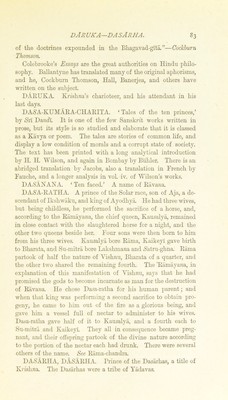
![world.” At the consummation of all things all are resolved into him. He is “ the sole-existent and universal soul,” and besides him there is no second principle; he is adwaita, ‘ without a second.’ /S'ankaracharya was the great apostle of this school The period of the rise of these schools of philosophy is uncer- tain, and is entirely a matter of inference, but they are probably later than the fifth century b.c. The Vedanta (Uttara-mimansa) is apparently the latest, and is supposed to have been evoked by the teachings of the Buddhists. This would bring it to within three or four centuries b.c. The other schools are to all ap]>ear- ance older than the Vedanta, but it is considered by some that all the schools show traces of Buddhist influences, and if so, the dates of all must be later. It is a question whether Hindu philosophy is or is not indebted to Greek teaching, and the later the date of the origin of these schools the greater is the possi- bility of Greek influence. Mr. Colebrooke, the highest authority on the subject, is of opinion that “ the Hindus were in this instance the teachers, not the learners.” Besides the six schools, there is yet a later system known as the Pauranik and the Eclectic school The doctrines of this school are expounded in the Bhagavad-gita (q.v.). The merits df the various schools have been thus summed up:— “ AVlien we consider the six Darsanas, we shall find that one of them, the Uttara-mimansa, bears no title to be ranked by the side of the others, and is really little more than a mystical explanation of the practical injunctions of the Vedas. Ve shall also admit that the earlier Vedanta, very diflferent from the school of Nihilists now existing under that name, was chiefly a controversial essay, seeking to support the theology of sacred writ, but borrowing all its philosophical portions from the Yoga school, the most popular at the time of its composition. Lastly, the Nyaya is little more than a treatise on logic, introducing the doc- trines of the theistic Saukhya; while the Vaiseshika is an essay on physics, with, it is true, the theory of atoms as its distinguishing mark, though even to this we feci inclined to refuse the imputa- tion of novelty, since we find some idea of it lurking obscurely in the theory of subtile elements which is brought forwanl in Kapila’s Saukhya, In short, the basis of all Indian philosojdiy, if indeed we may not say the only system of philosophy really discovered in India, is the Sankhya, and this forms the basis](https://iiif.wellcomecollection.org/image/b24876847_0118.jp2/full/800%2C/0/default.jpg)
 No text description is available for this image
 No text description is available for this image
 No text description is available for this image