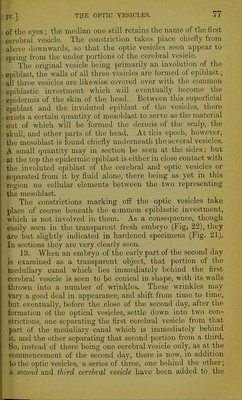
The elements of embryology. / By M. Foster ... and Francis M. Balfour.
- Michael Foster
- Date:
- 1874
Licence: Public Domain Mark
Credit: The elements of embryology. / By M. Foster ... and Francis M. Balfour. Source: Wellcome Collection.
Provider: This material has been provided by The University of Leeds Library. The original may be consulted at The University of Leeds Library.
106/336 (page 80)
![uniting above the alimentary canal in the back of the embrvo ■ to form the single dorsal aorta, which travelling backwards in ! the median line divides near the tail into two main branches, i From each of the two primitive aortse, or from each of the ' two branches into which the single aorta divides, there is | given off on either side a large branch. These have been [ j already spoken of as the omphalo-mesaraic arteries. At | | this stage they are so large that by far the greater part of ] the blood passing down the aorta finds its Avay into them, | and a small remnant only pursues a straight course into the X continuations of the aorta towards the tail Each omphalo-mesaraic artery leaving the aorta at nearly ' right angles (at a point some little way behind the backwai'd ; limit of the splanchnopleure fold which is forming the ali- ■ , mentary canal), runs outwards beneath the protovertebrse in j the lower range of the mesoblast, close to the hypoblast. ; Consequently, when in its course outwards it reaches the . < point where the mesoblast is cleft to form the somatopleure ■ i and splanchnopleure, it attaches itself to the latter. Travel- ! j ling along this, and dividing rapidly into branches, it reaches ' the vascular area in whose network of small vessels (and also j to a certain extent in the similar small vessels of the pellucid |l area) it finally loses itself. j| The terminations of the omphalo-mesaraic arteries in the Ijj vascular and pellucid areas are further connected with the \ heart in two different ways. From the network of capillaries, i j as we may call them, a number of veins take their origin, !| and finally unite into two main trunks, the omphalo-mesaraic j veins. These have already been described as running along the < \ folds of the splanchnopleure to form the venous roots of the i | heart. Their course is consequently more or less parallel to li that of the omphalo-mesaraic arteries, but at some little dis- ; tance nearer the head, inasmuch as the arteries run in that | part of the splanchnopleure which has not yet been folded in S to form the alimentary canal. Besides forming the direct i roots of the omphalo-mesaraic veins, the terminations of ? the omphalo-mesaraic arteries in the vascular area are also i connected with the sinus terminalis spoken of above as run- ;•; ning almost completely round, and forming the outer margin ;| of the vascular area. This (Fig. 23, s.v), may be best de- i} scribed as composed of two semicircular canals, which nearly ,](https://iiif.wellcomecollection.org/image/b2150684x_0108.jp2/full/800%2C/0/default.jpg)