On some forms of sudden death, and sudden death in general / by Alex. Ogston, M.D.
- Ogston, Alexander, Sir, 1844-1929.
- Date:
- [1869]
Licence: Public Domain Mark
Credit: On some forms of sudden death, and sudden death in general / by Alex. Ogston, M.D. Source: Wellcome Collection.
Provider: This material has been provided by The University of Glasgow Library. The original may be consulted at The University of Glasgow Library.
21/30 page 21
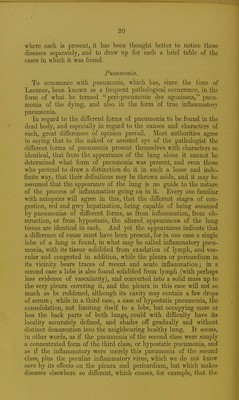
![serum in a case of acute peritonitis will give rise to a viruleut poi- soned wound when accidentally inoculated, while the fluid in ascites is utterly harmless. The term pneumonia from obstruction has been applied to some forms of lung inflammation by a recent M'riter on pneumonia. Dr. Octavius Sturges, who in an admirable paper in ' St. George's Hospital Reports' for 1867, has discussed this subject fully and with great abihty. Dr. Sturges divides pneumonia hito four classes. 1st. Pneumonia in debilitating diseases. 2nd. Pneumonia in specific fever, or where some secreting organ is interfered with, i. e. in blood poisoning. 3rd. Pneumonia owing to mechanical causes. 4th. Pneumonia from idiopathic lung inflammation. In his paper on this subject. Dr. Sturges shows that we are, by mechanical means, in a position to imitate the state of hyperoemia and congestion preceding inflammation ('St. George's Hospital Reports,'' 1867, p. 219). Venous obstruction, he says, and he cites Simon's Lectures in support of his statements, however produced will give rise to an exudation which will be serous, or albuminous, or spontaneously coagulable, according as the pressure is less or greater. Quoting also a paper by Dr. Robinson in the 26th volume of the ' Medico-Chirurgical Transactions,' Dr. Sturges shows satisfactorily that in the stage of fibrinous effusion which has been mechanically produced in the kidneys by obstructing the flow of blood through the renal vein, the difference between the appear- ances found and those present in inflammation is more of degree than of kind, and applying the observations and arguments to the lungs, he proves (I. c. pp. 220—221) that a pneumonic infiltration from obstruction is a highly probable phenomenon. But it seems to me that while quite justified in assuming that there is an obstructive, as distinguished from an inflammatory pneumonia. Dr. Sturges has not made out the same claim to separate the obstructive inflammations, under which head are included, not only those where obstructive heart disease is present, but also those where alterations of the blood, or loss of power of the heart exist, from hypostatic pneumonia; and further, that his fourth class of idiopathic pneumonia ought by rights to include his second class of inflammation occurring during specific fever and interrupted secre- tion, a class in which, he says, the lung affection occurs with marked local symptoms, resembling idiopathic pneumonia, with which, indeed, it may be pathologically identical. It would seem, on the contrary, more philoso])hical to class together all pneumonias where the true inllammatory element is l)resent, and which would all be characterised by the sympathy of the system generally with the local disease, as expressed in the](https://iiif.wellcomecollection.org/image/b21480989_0021.jp2/full/800%2C/0/default.jpg)



 No text description is available for this image
 No text description is available for this image
 No text description is available for this image