Disposal and purification of factory wastes or manufacturing sewage / by H. W. Clark.
- Date:
- 1910
Licence: In copyright
Credit: Disposal and purification of factory wastes or manufacturing sewage / by H. W. Clark. Source: Wellcome Collection.
Provider: This material has been provided by London School of Hygiene & Tropical Medicine Library & Archives Service. The original may be consulted at London School of Hygiene & Tropical Medicine Library & Archives Service.
36/72 page 34
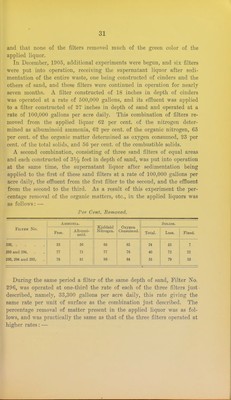
![Waste Liquors from Paper Mills. The waste liquors from paper mills can be divided into two groups, the first including the waste liquors from washing and preparing the stock, and the second including waste liquors produced in working this stock up into paper. The volume of the liquors from washing and pre- paring the stock is much smaller than that used in the process of manu- facture, but it contains a much larger percentage of organic matter. The total volume of waste liquors discharged from a paper mill is generally very large. This volume in 1895 from two plants, taken as good examples of the paper-making industry in Massachusetts, varied in both cases between 2,000,000 and 3,000,000 gallons per day. In one plant there was worked up yearly about 5,100 tons of a stock consisting largely of old paper, but including a considerable amount of old rope and bagging, and also a small amount of old oilcloth. In making this stock into paper about 1,000 tons of chemicals and dyestuffs were used yearly, consisting of alum, quicklime, chloride of lime or bleach, soda ash, cop- peras, china clay, caustic soda, starch, aniline dyes, bichromate of lead, etc. The second mill investigated as to the volume of its waste liquor produced about 4,000 tons of paper yearly, and used also a very large amount of chemicals, dyestuffs, etc. The waste liquors produced by boiling rags in caustic soda, caustic lime, or mixtures of soda ash and lime, in order to free them from grease, dirt and coloring matter, are of such composi- tion that it is practically impossible to purify them by intermittent filtration. A sand filter operated at the station in 1895, to which such a liquor Avas applied, gave very poor results, and other experiments made since that date with like liquors have resulted similarly. The following table gives the average analysis of the liquor applied to and of the effluent from the filter mentioned, — Filter No. 60, %0000 of an acre in area and containing 5 feet in depth of sand of an effective size of 0.25 millimeter. It Avas operated at the rate of 65,000 gallons per acre daily. Average Analysis of Liquor Applied to Filter No. 60. [Parts per 100,000.] Ammonia. Chlorine. Nitrogen as — Oxygen Consumed. Bacteria per Cubic Centimeter. Free. Albuminoid. Nitrates. Nitrites. 2.30 5.10 20.00 .0000 .0000 140.00 - Average Analysis of Effluent from Filter No. 60. 2.29 12.59 .1050 .0067 84.36](https://iiif.wellcomecollection.org/image/b2476579x_0038.jp2/full/800%2C/0/default.jpg)




 No text description is available for this image
 No text description is available for this image
 No text description is available for this image