History of British costume, from the earliest period to the close of the eighteenth century / by J.R. Planché.
- James Planché
- Date:
- 1847
Licence: Public Domain Mark
Credit: History of British costume, from the earliest period to the close of the eighteenth century / by J.R. Planché. Source: Wellcome Collection.
107/518 page 79
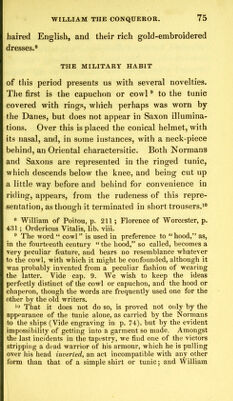
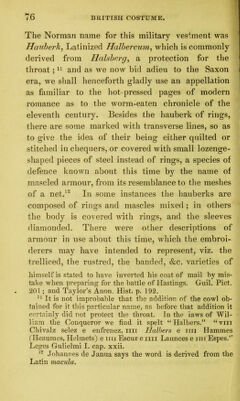
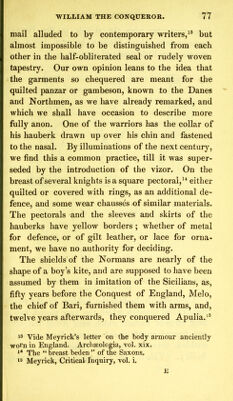
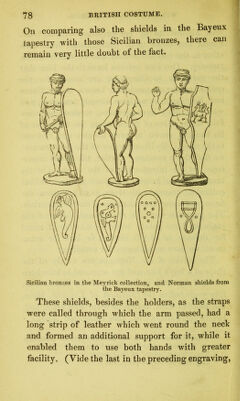
![which presents the inner side, with the strap twisted.) This extra strap was called the guige, and the Norman poet remarks the advantage it gave his countrymen over the Saxons, who, he says, did not know how to joust (tilt), nor to carry arms on horseback. “ When they wished to strike with their battle-axe, they were forced to hold it with both hands. To strike strong, and at the same time to cover themselves, was what they could not do : ” for the Anglo-Saxon shield was, as we have before mentioned, held at arm’s length by the clenched hand (a distinction particularly attended to in the tapestry). The wielders, there- fore, of double-handed weapons either could not carry such a protection, or must drop it for the blow. Some of the Norman shields bear the rude effi- gies of a dragon, griffin, serpent, or lion ; others, crosses, rings, and various fantastic devices; but no regular heraldic bearings. A griffin is observable on one of the Sicilian shields, but, as might be ex- pected, in better drawing. In the Bayeux tapestry, William and his principal knights are seen with lances, ornamented with small flags or streamers, which were termed in the language of that day Gonfanons or Gonfalons. [Vide cut p. 74.] Upwards of seven hundred years have elapsed since the Conquest; the lance has again become an English military weapon, and the streamer is still attached to it.](https://iiif.wellcomecollection.org/image/b22029163_0107.jp2/full/800%2C/0/default.jpg)