Content advisory
This digitised material is free to access, but contains information or visuals that may:
- include personal details of living individuals
- be upsetting or distressing
- be explicit or graphic
- include objects and images of objects decontextualised in a way that is offensive to the originating culture.
Licence: In copyright
Credit: Spetsai Summer School. Source: Wellcome Collection.
7/66
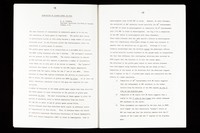
![M Horst Feldmann I. Organization and Expression of tRNA Genes The arrangement of tRNA genes in prokaryotes and eukaryotes is differing in many respects [l,2]. This leads to differences in transcription and also in post-transcriptional processing which is necessary for the production of functional tRNAs. Some of these modification steps have been studied in detail ¡e.g. 3,4]. Recent results [5] on the organization and expression of tRNA genes in bacterial systems (mainly E. coli and its phages) and several eukaryotic systems [6] (including organelles) will be compared and discussed. fl] J.D. Smith in: Progress in Nucleic Acids Research and Molecular Biology 16 (W.E. Cohn, ed.) 1976, pp. 25-73 [2] Transfer RNA: Biological Aspects (D. Söll, J. Abelson, and P. Schimmel, eds.) Cold Spring Harbor Monographs, 1980 [3] R. Kole, M.F. Baer, B.C. Stark and S. Altmann (1980) Cell 19, 881-888 Ü4] G. Knapp, R.C. Ogden, G.L. Peebles, and J. Abelson (1979) Cell 18, 37-45 [5] EMBO-FEBS tRNA Workshop, Strasbourg 1980 [6]] e.g. and bibliography: B. Hovemann, S. Sharp, H. Yamada, and D. Söll (1980) Cell 19, 889-895 II. Movable Genetic Elements Genetic elements that can transpose into different chromosomal sites causing a modulation of gene expression have been found in several organisms £ 1—3] : most intensively characterized are the insertion sequences in enterobacteria, the transposable drug resistance genes, and phage Mu [4,5]. currently, the best understood eukaryotic models are mobile elements in Drosophila [e.g. 6-8] and yeast [e.g. 9,lo]. An overview will be presented and common features of transposition will be discussed. [1] DNA insertion elements, plasmids and episomes (A.I. Buhkari, J.A. Shapiro, and S.C. Adhya, eds.) cold Spring Harbor Lab. 1977 [2] Movable genetic elements (A.I. Buhkari and Hicks, J.B.,eds.) XLV Cold Spring Harbor Symp. Quant. Biol. 1980 [3] Cabs, M.P. and Miller, J.H., Cell, in press [4] Kleckner, N. (1977) Cell JJ., 11-23 [53 Starlinger, P. (1980) Plasmid 3. 241-259 43 [6] Finnegan, D.J., Rubin, G.M., Young, M.W., and Hogness, D.S. (1978) Cold Spring Harbor Symp. Quant. Biol. 42, 1053-1063 [7] Tchurikov, N.A., Ilyin, Yu.V., Ananiev, E.V., and Georgiev, C.P. (1978) Nucl. Acids Res. 5. 2169-2187 [8] Gehring, W. and Paro, R., Cell, in press [9] Cameron, J.R., Loh, E.Y., and Davis, R.W. (1979) Cell 16, 739-751; Gafner, J. and Philippsen, P. (1980), Nature, in press Ilo] Greer, H. and Fink, G. (1979), Proc. Natl. Acad. Sci. USA 76 , 4006-4010 III. What is Interesting in Yeast The yeast Sacciharomyces cerevisiae is an attractive eukaryotic model system [l] . Yeast can be grown vegetatively, but on the other hand mating of cells of opposite mating type will allow tetrade analysis which facilitates yeast genetics. Genetic engineering in the yeast system became feasible through the construction of shuttle vectors for yeast and E. coli [e.g. 2,3], some of which contain portions of the 2|i yeast DNA [4]. A variety of yeast genes have been investigated: ribosomal RNA genes, which also served as a model for sister chromatical exchange [5], tRNA genes (see above), regulatory genes in cell division cycle [e.g. 6] or replication [e.g. 2], mating type genes [7], which belong to the transposable genetic elements, and a number of other structural genes. £l] The Molecular Biology of Yeast, (Broach, J., Hicks, J., Klar, A., and Strattern, j., eds.) Cold Spring Harbor Lab. 1979 [2] K. Struhl, D.T. Stinchcomb, S. Scherer, and R.W. Davis (1979), Proc. Natl. Acad. Sci. USA lb_- 1035-1039 [33 L. Clarke and J. Carbon (1980) Proc. Natl. Acad. Sci. USA 21. 2173 [4] Bibliography in: R.G. Nelson and W.L. Fangman (1979), Proc. Natl. Acad. Sci. USA 76, 6515-6519 [5] J.W. Szostak and P. Wu (1980) Nature 284, 426; T.D. Petes (1980) Cell JL9, 765 [6] K.A. Nasmyth and S.I. Reed (1980) Proc. Natl. Acad. Sci. USA 21' 2119-2123 [7] Review: U. Leupold, Nature 283, 811 (1980) IV. In supplementing the lecture on yeast mitochondrial DNA, some aspects of mammalian mitochondrial genomes may be discussed [1.2]. [1] Genetics and Biogenesis of Mitochondria (W. Bandlow R.J. Schweyen, K. Wolf, and F. Kaudewitz) 1977, W. de Gruyter, Berlin, New York [2] e.g.: B.G. Barwell, A.T. Bankier, and J. Drouin (1979) Nahire 9Ö9 1 QQ_1 QA](https://iiif.wellcomecollection.org/image/b1816383x_PP_CRI_E_1_28_13_0007.jp2/full/800%2C/0/default.jpg)





 No text description is available for this image
 No text description is available for this image
 No text description is available for this image