The microscopic organisms found in the blood of man and animals and their relation to disease. / By Timothy Richards Lewis.
- Timothy Richards Lewis
- Date:
- 1879
Licence: Public Domain Mark
Credit: The microscopic organisms found in the blood of man and animals and their relation to disease. / By Timothy Richards Lewis. Source: Wellcome Collection.
Provider: This material has been provided by Royal College of Physicians, London. The original may be consulted at Royal College of Physicians, London.
56/112 (page 44)
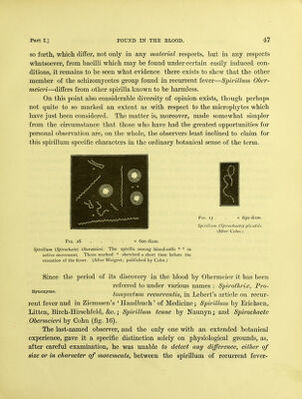
![presumably coinciding with the original number of segments. The threads are wider when containing spores than previously. The spores = 1 to 1'4<^«- in length, by '8 to la in breadth. The space allotted to each spore in a filament, presumably each segment, was from 6 to 7f* in length, so that a filament con- taining 2 spores would equal 12 to 14//-, and 3 spores = 18 to 21ju,, and so on, so that the filament manifestly swells out in all directions.' The third day: ' Having set the shde in moist air under a bell-glass, evapo- ration was prevented. Not much change has taken place, except that here and there it is seen that some of the spores within the filaments present a longer appearance, and have become correspondingly narrower. In some a constriction is seen, and others are completely divided and form two minute molecules (Plate I, figure 8). In some instances the molecules had become separated. [Compare with Dr. Ewart's figure of bacillus anthracis, figure 9.] That the refringent particles were in reality the spores of the previously distinctly seen filaments was evident from the circumstance that, although the hyaline tube which contained them was extremely translucent and only with difficulty brought into view, still it was sufficiently strong to be able to retain these refractive molecules in a row; any movement communicated to one part of the row was seen to be accompanied by movement of the entke series. The movements were caused by the constant agitation of objects in the field on account of the presence of hacterivmi termoJ No further change could be detected in the ' spores.' The foregoing description, though applying to the more generally observed Large-size bacilli: modifying in- appcarauccs which baciUus growths present, is by fluences ot cultivating media, mcaus the Only coursc taken by such organisms when transferred to nutritive media other than that in which they were de- veloped, nor is it by any means a matter of certainty, at starting, what particular course will be followed by them. In illustration of this and also of the fact that, occasionally, exceptionally large bacilli are to be found predominating in the blood (just as we have seen to be the case with regard to exceptionally small ones), the following extract from my note-book may be instructive:— A rat which had been killed at 10 o'clock in the morning was dissected at 5 in the afternoon of the same day. The tempera- cuitivation-fiTBt day. turc had bccu about 94° P. The heart was carefully taken out and a minute quantity of blood transferred,](https://iiif.wellcomecollection.org/image/b22651494_0056.jp2/full/800%2C/0/default.jpg)