The stone ages in North Britain and Ireland / by the Rev. Frederick Smith ; with an introduction by Augustus H. Keane.
- Smith, Frederick, Rev.
- Date:
- 1909
Licence: In copyright
Credit: The stone ages in North Britain and Ireland / by the Rev. Frederick Smith ; with an introduction by Augustus H. Keane. Source: Wellcome Collection.
333/413 page 304
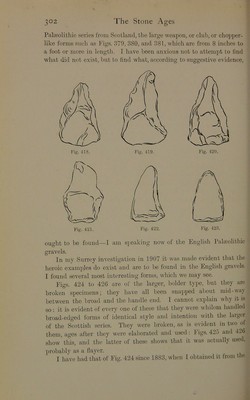
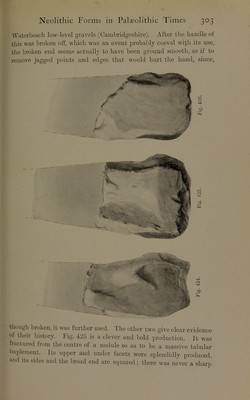
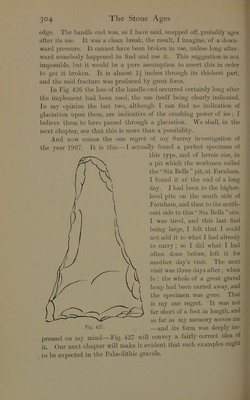
![f edge. The handle end was, as I have said, snapped oh', probably ages after its use. It was a cdean break, the result, I imagine, of a down- ward pressure. It cannot have been broken in use, unless long after- ward somebody happened to find and use it. This suggestion is. not impossible, but it would be a pure assumption to assert this in order to get it broken. It is almost inches through its thickest part, and the said fracture was produced by great force. In Fig. 426 the loss of the liandle-end occurred certainly long after the implement had been used, the use itself being clearly indicated. In my opinion the last two, although I can find no indication of glaciation upon them, are indicative of the crushing power of ice; I believe them to have passed through a glaciation. We shall, in the next chapter, see that this is more than a possibihty. And now conies the one regret of my Surrey investigation of the year 1907. It is this—I actually found a perfect specimen of this type, and of heroic size, in Fig. 4‘27. a pit which the workmen called the “Six Bells ” pit, at Faruham. I found it at the end of a long day. I had been to the higher- level pits on the south side of Farnhani, and then to the north- east side to this “ Six Bells ” site. I was tired, and this last find being large, I felt that I could not add it to what I had already to carry ; so I did what I had often done before, left it for another day’s visit. The next visit was three days after; when lo ! the whole of a great gravel hea]) had been carted away, and the specimen was gone. That is my one regret. It Wiis not far short of a foot in leugtli, and so far as my memory serves me —ami its form was deeply im- pressed on my mind—Fig. 427 \vill convey a fairly correct idea of it. Our next chapter will make it evident that such examples ought to be expected in the Paheolithic gravels.](https://iiif.wellcomecollection.org/image/b24885691_0332.jp2/full/800%2C/0/default.jpg)