The stone ages in North Britain and Ireland / by the Rev. Frederick Smith ; with an introduction by Augustus H. Keane.
- Smith, Frederick, Rev.
- Date:
- 1909
Licence: In copyright
Credit: The stone ages in North Britain and Ireland / by the Rev. Frederick Smith ; with an introduction by Augustus H. Keane. Source: Wellcome Collection.
357/413 page 328
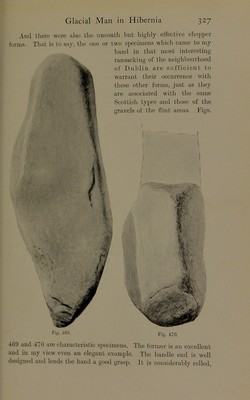
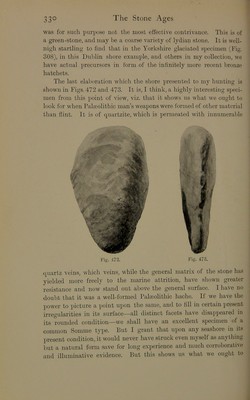
![but not sufficiently to hide the evidence that the whole thing was very skiliully elaborated from a parent mass. It is of limestone, a rock from which fine specimens from the Forth estuary are formed. It is 11 inches in length, and is from the shore, Killiney Bay. The drawing sufficiently illustrates it. Fig. 470 is a chopper of a different type; I have several identical with it from Scotland. The blade ends of this type are often massive, yet of good form, as in this case; they are almost always minus the handle, the whilom presence of which is generally indicated by a conspicuous break of more recent aspect than the general surface of the implement. This specimen, which is an excellent one, shows clearly that it once possessed a well-defined, cleverly devised handle. It is, as appears to me, perfectly natural that these heavy-hladed, slender-handled choppers should have come down to us mainly as blades only. The drawing, with the suggested handle, gives us an idea of what the form was; and if we realise that the broad hack of this “blade” is from 2 to 2| inches through, though the opposing edge is still appreciably chopper-like, we shall understand how liable handle and blade were to part company. This is from the shore at Sutton. It is not greatly rolled; but it is honeycombed with age upon the surface, and is bleached—a bleached limestone. Some of the Scot- tish examples exhibit a similarly bleached condition. I am anxious to trace these chopper forms to the boulder-clays, whence, I believe, many have come. I have, without actually finding good in situ specimens, seen sufficient to warrant my belief in then- origin at least in part in such glacial deposits. Theii’ counterparts unquestionably occur among the Paleolithic gravels of England, and I now have before me a highly glaciated blade end, or what I take to be such, of a chopper form of the same type as this last, which I extracted from a “ concrete ” portion of the Killiney Bay cliff. It is roughly fretted, especially along the thick “ back,” and the handle is no more. The chopping edge is fairly intact. Fragments of the natiu’al cement are still adhering to it. While it is not a typical specimen, it is, to myself, a highly interesting and suggestive one. And the fan-shaped, scapula-like forms are also to be found along the shore. I found one of unusually excellent attributes. It is ot fine form and perfect, except that it is slightly rolled. I have items like it in general expression from Scotland. It is ot the siime type as the fine glaciated specimen which Mr. ]\I. P>. Cotsworth found in the boulder-clay of the Yorkshire coast. The Hint lind which I so](https://iiif.wellcomecollection.org/image/b24885691_0356.jp2/full/800%2C/0/default.jpg)