The stone ages in North Britain and Ireland / by the Rev. Frederick Smith ; with an introduction by Augustus H. Keane.
- Smith, Frederick, Rev.
- Date:
- 1909
Licence: In copyright
Credit: The stone ages in North Britain and Ireland / by the Rev. Frederick Smith ; with an introduction by Augustus H. Keane. Source: Wellcome Collection.
377/413 page 348
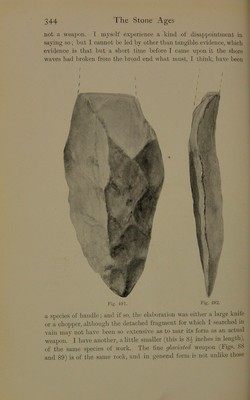
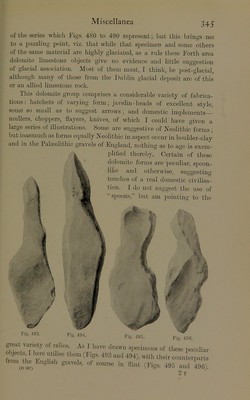
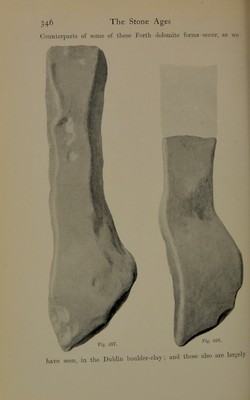
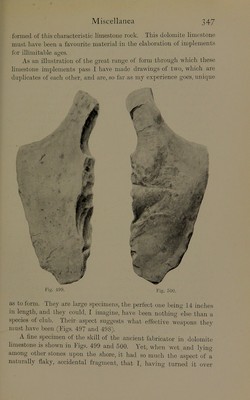
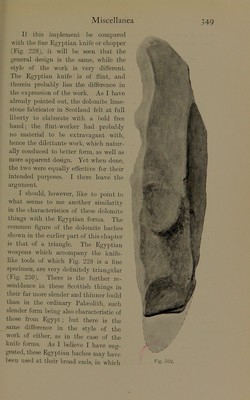
![with my Joot, cjoucluded it to be sucli; tlie whole of tlie iigure (499) pieseuts a natural (cleavage) surface. Hut the work u]>oii the “ back ” (to the right of Fig. 499) attracted notice, and that prevented the loss of so line a specimen, lhat work is characteristically artificial. So is that of the whole of its other face (Fig. 500), a double bulb-of-per- cussiou Ijeing perceptible to the left, midway between the handle and the point. Ihe handle, though only the re.sult of portions being broken out laterally, was very skilfully produced; indeed the whole form is fine. It was a knife or flayer, possibly both in turn. lig. 501 is interesting as having occurred at the same spot, though at another time, as the fore- going. They were both brought in from the deep sea. The handle in this is identical with Fig. 499 in form and in the manner in wdiich it was pro- duced. It was, I should say, a knife of unusual style, but still in work and intention distinctly related to Fig. 499. I might have given drawings of several other dolomite knives, more of the character of what we should style knife- blades, mainly small—from 2 to 3 or 4 inches in length, 5QJ had space permitted. I have made drawings of two further specimens, both of which might have been knives, while one of them may have been an effective chopper:— Fig. 502 is a large rugged production, so rugged in style that among other stones it had apparently no more design or intention about it than a lump in our coal-scuttle; but I have learned to look twice at most stones upon any seashore, and the second look at this detected the intention of its form. In the drawing it will be clear to the reader that there is evidence of l)old but equally clever flaking upon the side of the implement', shown; while the handle and the dark facet to the right, which was bevelled to an excellent edge, with the general figure, to which I have a]ipended tentatively a restored point end, form distinct evidences of intention.](https://iiif.wellcomecollection.org/image/b24885691_0376.jp2/full/800%2C/0/default.jpg)