Researches in colour vision and the trichromatic theory / by Sir William de W. Abney.
- William de Wiveleslie Abney
- Date:
- 1913
Licence: Public Domain Mark
Credit: Researches in colour vision and the trichromatic theory / by Sir William de W. Abney. Source: Wellcome Collection.
61/452 page 41
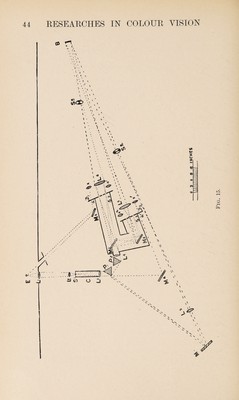
![X Y X Y: grooves cut in it (see Fig. 13). A, B, and C are three slits which can be clamped in any position by means of the screw GG. H is a slit which is always kept in one position and has a fixed and carefully measured opening (used for measures to be compared together from time to time). (There is a transparent scale S fitted into D, through which a beam of light passes on to a distant screen with a mark on it; see p. 45.) XX are two grooves cut the whole length of the top and bottom bars, as also are YY. In XX the slits (of which a full-size figure of one is shown in Fig. 14) slide along XX and thin black cards EE in YY, Fig. 12. The slits in the brass frame, it will be seen, are made to open centrally, so that the centre line of any aperture is always in one position. The brass frame F is fixed to a hard-wood slide D (in which there is a rather smaller opening than the dimensions of the brass plate). This apparatus is all that is, as a rule, required for colour measurement and mixture. [It may here be noted that by re¬ moving the slide at D, and then placing a lens of 9- or 10-inch focus some 4 inches in front of the recombining lens, an enlarged spectrum can be obtained on a white screen placed at the same distance as the cube.] The lens L1, which throws an image of the crater of the arc, should have such a focal length that the length of the slit is well covered by the brightest part. Fig. 14.](https://iiif.wellcomecollection.org/image/b31350574_0061.jp2/full/800%2C/0/default.jpg)