Researches in colour vision and the trichromatic theory / by Sir William de W. Abney.
- William de Wiveleslie Abney
- Date:
- 1913
Licence: Public Domain Mark
Credit: Researches in colour vision and the trichromatic theory / by Sir William de W. Abney. Source: Wellcome Collection.
63/452 page 43
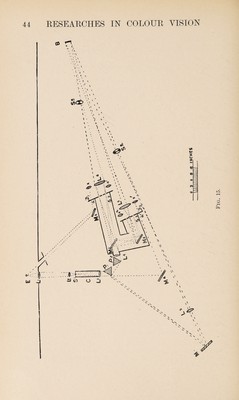
![to the main spectrum. Thus two similar spectra are placed side by side. The accompanying diagram will show the arrangement. As in the apparatus described, E is the source of light used outside a darkened room, Lp L„ are lenses throwing an image of the source of light on the slit S2 of the collimator C. The parallel beam passes through the prisms P4, P2 and is received on a colour-corrected photographic lens, L4, of sufficient diameter to take in the whole of the light coming through the prisms. The lens forms a spectrum on a focusing screen at D15 which can be removed and slits S2 placed in the image. L6 collects the colours and gives an image of the face of the prism P] on the screen B. Behind the lens L4 is placed the semi-silvered mirror Mp reflecting, as nearly as may be, the same amount of light as is transmitted through it. If the mirror be on a plate of glass with parallel sides, it should be as thin as possible, to avoid any serious mixture of colour in the second spectrum due to the reflection of the unsilvered surface. If a plate be made up of D two thin prisms, as in margin, with the surface AB of one of them half silvered, the transmitted beam is A not deviated, and the beams reflected from DB and AC 1 are diverted and not used. The reflection from the semi-silvered mirror M4 falls on a silvered mirror, M.„ which reflects the beam in such a direction that it falls on B, the image of the spectrum being thrown on D2. The image of P, is thrown on B by the lens L_. A beam of white light is reflected from 1 The two thin prisms are used in order to protect the silvered surface. One thin prism by itself may be employed, but the length of the direct spectrum will be slightly increased or diminished according to the position of the thin end of the wedge.](https://iiif.wellcomecollection.org/image/b31350574_0063.jp2/full/800%2C/0/default.jpg)