Women, food, and families / Nickie Charles and Marion Kerr.
- Nickie Charles
- Date:
- [1988]
Licence: Attribution-NonCommercial-NoDerivatives 4.0 International (CC BY-NC-ND 4.0)
Credit: Women, food, and families / Nickie Charles and Marion Kerr. Source: Wellcome Collection.
88/264 page 76
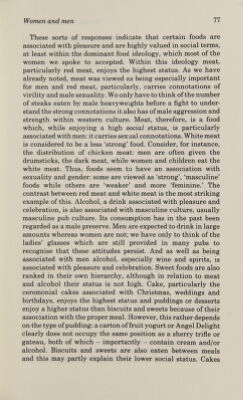
![76 Women, food and families Oh yeah. That's how I got him [laughter!] I think it is yes actually. I think a lot of men look for a woman to how their mother is. 'Cos I mean I run about after him really a bit silly at times. If he won't hang his clothes up I'll hang 'em up. At one time I left them for a week and they were just piled up. I nearly drowned in the pile. And he says, 'You'll get sick of this before me', and I did ... I think a lot look for a wife that's like their mother ... I mean if they didn't like your cooking they'd be always at the fish shop or somewhere like that - or round at his mother's. All these factors mean that women tend to cook food according to their partners' preferences on a daily basis. So that, really, men are pampered, their tastes are catered for in the very way that a family's diet is structured. As one woman, who said she never 'treated' her partner with food, put it: 'I know the things he has more of a liking for and I class a lot of that really as every day but usually, two or three times a week, I'll do the stuff that I know he likes best.' Food distribution The privileging of men was also evident in the distribution of food between women and men and between boys and girls within our families. There were certain foods which enjoyed a higher social status than others. This became clear from the women's accounts, especially when they were talking about the foods they would eat for a treat. We have already mentioned meals eaten in restaurants in this context, but it is important to look at what such meals might consist of. They usually contained a high status meat, such as steak, alcohol, cream and pudding or gateau. A working-class woman described a treat for herself: 'A nice fillet steak with mushrooms and chips, and after that a nice big piece of gateau, and then one of those coffees with cream on top - Irish coffee, and cheese and crackers.' She would drink brandy with this type of meal. Sweet foods were often treats, particularly if they were not eaten regularly. Chocolate, cream cakes and 'sticky, gooey' puddings were all mentioned by the women when they spoke about the foods they would like to buy but were unable to afford. Comments such as, 'I'd buy a nice piece of meat for a treat - beef - we never, ever have beef, apart from special occasions - Christmas!' were legion.](https://iiif.wellcomecollection.org/image/b18028706_0089.JP2/full/800%2C/0/default.jpg)