Physiology at Harvard / by William Townsend Porter.
- William Townsend Porter
- Date:
- 1902
Licence: Public Domain Mark
Credit: Physiology at Harvard / by William Townsend Porter. Source: Wellcome Collection.
Provider: This material has been provided by the Augustus C. Long Health Sciences Library at Columbia University and Columbia University Libraries/Information Services, through the Medical Heritage Library. The original may be consulted at the the Augustus C. Long Health Sciences Library at Columbia University and Columbia University.
59/88 page 45
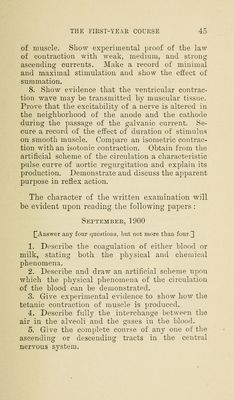
![of muscle. Show experimental proof of the law of contraction with weak, medium, and strong ascending currents. Make a record of minimal and maximal stimulation and show the effect of summation. 8. Show evidence that the ventricular contrac- tion wave may be transmitted by muscular tissue. Prove that the excitability of a nerve is altered in the neighborhood of the anode and the cathode during the passage of the galvanic current. Se- cure a record of the effect of duration of stimulus on smooth muscle. Compare an isometric contrac- tion with an isotonic contraction. Obtain from the artificial scheme of the circulation a characteristic pulse curve of aortic regurgitation and explain its production. Demonstrate and discuss the apparent purpose in reflex action. The character of the written examination will be evident upon reading the following papers : September, 1900 [[Answer any four questions, but not more than four.] 1. Describe the coagulation of either blood or milk, stating both the physical and cheniical phenomena. 2. Describe and draw an artificial scheme upon which the physical phenomena of the circulation of the blood can be demonstrated. 3. Give experimental evidence to show how the tetanic contraction of muscle is produced. 4. Describe fully the interchange between the air in the alveoli and the gases in the blood. 5. Give the complete course of any one of the ascending or descending tracts in the central nervous system.](https://iiif.wellcomecollection.org/image/b2121055x_0059.jp2/full/800%2C/0/default.jpg)
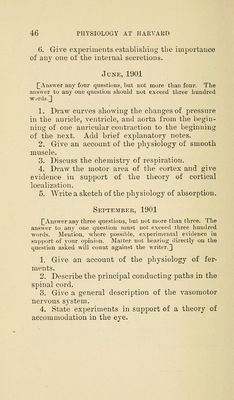
 No text description is available for this image
 No text description is available for this image
 No text description is available for this image