Three presidential addresses to the Chemical Section of the Philosophical Society of Glasgow : on the study of the history of chemistry, recent inquiries into the early history of chemistry, eleven centuries of chemistry / by John Ferguson.
- John Ferguson
- Date:
- 1879
Licence: Public Domain Mark
Credit: Three presidential addresses to the Chemical Section of the Philosophical Society of Glasgow : on the study of the history of chemistry, recent inquiries into the early history of chemistry, eleven centuries of chemistry / by John Ferguson. Source: Wellcome Collection.
Provider: This material has been provided by The Royal College of Surgeons of England. The original may be consulted at The Royal College of Surgeons of England.
3/60
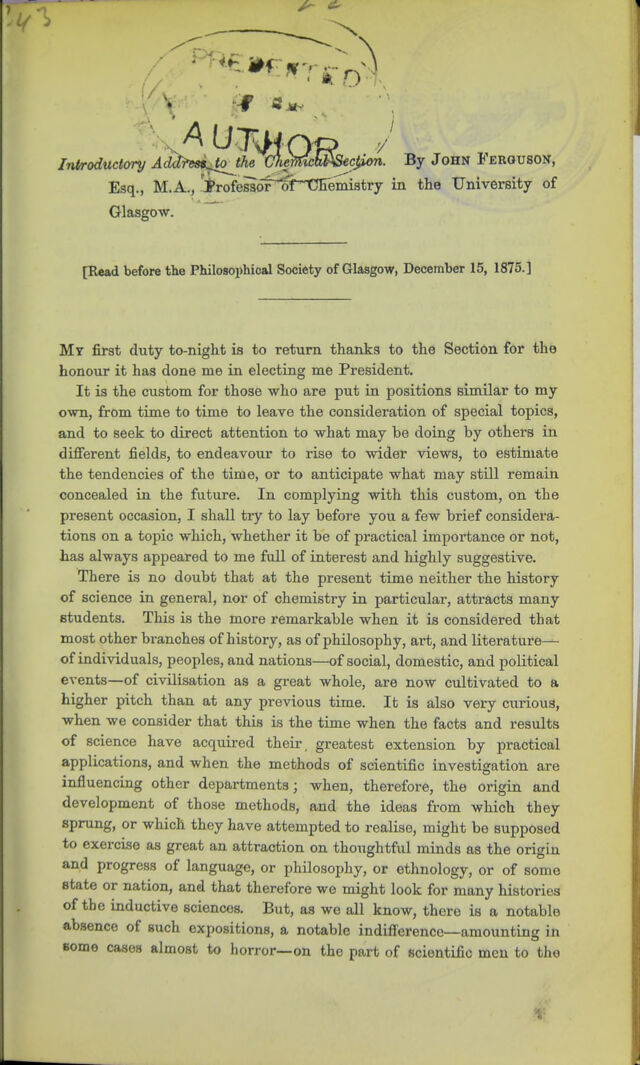
![^ Introductory Addr^tojhe CJiemchlJSecjSon. By John Ferguson, Esq., M.A., Trofeslor^of^CFemistry in the University of Glasgow. [Read before the Philosophical Society of Glasgow, December 15, 1875.] My first duty to-night is to return thanks to the Section for the honour it has done me in electing me President. It is the custom for those who are put in positions similar to my own, from time to time to leave the consideration of special topics, and to seek to direct attention to what may be doing by others in different fields, to endeavour to rise to wider views, to estimate the tendencies of the time, or to anticipate what may still remain concealed in the future. In complying with this custom, on the present occasion, I shall try to lay before you a few brief considera- tions on a topic which, whether it be of practical importance or not, has always appeared to me full of interest and highly suggestive. There is no doubt that at the present time neither the history of science in general, nor of chemistry in particular, attracts many Btudents. This is the more remarkable when it is considered that most other branches of history, as of philosophy, art, and literature— of individuals, peoples, and nations—of social, domestic, and political events—of civilisation as a great whole, are now cultivated to a higher pitch than at any previous time. It is also very curious, when we consider that this is the time when the facts and results of science have acquired their, greatest extension by practical applications, and when the methods of scientific investigation are influencing other departments; when, therefore, the origin and development of those methods, and the ideas from which they sprung, or which they have attempted to realise, might be supposed to exercise as great an attraction on thoughtful minds as the origin and progress of language, or philosophy, or ethnology, or of some state or nation, and that therefore we might look for many histories of the inductive sciences. But, as we all know, there iB a notable absence of such expositions, a notable indifference—amounting in some cases almost to horror—on tho part of scientific men to the](https://iiif.wellcomecollection.org/image/b22292913_0005.jp2/full/800%2C/0/default.jpg)