Volume 1
Report of the royal commissioners appointed to inquire whether any and what kind of new university or powers is or are required for the advancement of higher education in London, together with an appendix.
- Great Britain. University for London Commission.
- Date:
- 1889
Licence: Public Domain Mark
Credit: Report of the royal commissioners appointed to inquire whether any and what kind of new university or powers is or are required for the advancement of higher education in London, together with an appendix. Source: Wellcome Collection.
Provider: This material has been provided by Royal College of Physicians, London. The original may be consulted at Royal College of Physicians, London.
26/32
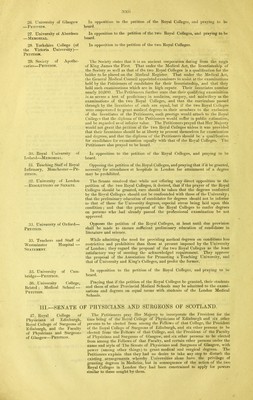
![26. University of Glasgow —Petition. 27. University of Aberdeen —Memorial. 28. Yorkshire College (of the Victoria University)— Petition. 29. Society of Apothe- caries—Petition. 30. Royal University of Ireland—Memorial. 31. Teaching Stafi'of Eoyal Infirmary, Manchester—Pe- tition. 32. University of London —Resolutions of Senate. 33. University of Oxford- Petition. 33. Teachers and Staff of Westminster Hospital — Statement. 35. University of bridge—Petition. Cam- 36. University Bristol; Medical Petition. College, School — In opposition to the petition of the Royal Colleges, and praying to be heard. In opposition to the petition of the two Royal Colleges, and praying to be heard. In opposition to the petition of the two Royal Colleges. The Society states that it is an ancient corporation dating from the reign of King James the First. That under the Medical Act, the licentiateship of the Society as well as that of the two Royal Colleges is a qualification for the holder to be placed on the Medical Register. That under the Medical Act, the Genera] Medical Council appointed examiners to assist at the examinations held by the Petitioners of candidates for their licentiateship, and that they hold such examinations which are in high repute. Their licentiates number nearly 10,000. The Petitioners further state that their qualifying examination is as severe a test of proficiency in medicine, surgery, and midwifery as the examinations of the two Royal Colleges, and that the curriculum passed through by the licentiates of each are equal, but if the two Royal Colleges were empowered to grant medical degree:; to their members to the exclusion of the licentiates of the Petitioners, svTch prestige would attach to the Royal Colleges that the diploma of the Petitioners would suffer in public estimation, and be regarded as of inferior value. The Petitioners prayed that Her Majesty would not grant the petition of the two Royal Colleges unless it was provided that their licentiates should be at liberty to present themselves for examination and degrees, and that the diploma of the Petitioners should be a qualification for candidates for examination equally with that of the Royal Colleges. The Petitioners also prayed to be heard. In opposition to the petition of the Royal Colleges, and praying to be heard. Opposing the petition of the Royal Colleges, and praying that if it be granted, necessity for attendance at hospitals in London for attainment of a degree may be prohibited. The Senate resolved that while not offering any direct opposition to the petition of the two Royal Colleges, it desired, that if the prayer of the Royal Colleges should be granted, care should, be taken that the degrees conferred by the Royal Colleges should not be confounded with those of the University ; that the preliminary education of candidates for degrees should not be inferior to that of those for University degrees, especial stress being laid upon this condition ; and that the proposal of the Royal Colleges to confer degrees on persons who had already passed the professional examination be not approved. Opposes the petition of the lioyal Colleges, at least until due provision shall be made to ensure sufficient preliminary education of candidates in literature and science. While admitting the need for providing medical degrees on conditions less restrictive and prohibitive than those at present imposed by the University of London; they regard the proposal of the two Royal Colleges as the least satisfactory way of meeting the acknowledged requirement. They approve the proposal of the Association for Promoting a Teaching University, and that of University and King's Colleges, and prefer the former. In opposition to the petition of the Royal Colleges, and praying to be heard. Praying that if the petition of the Royal Colleges be granted, their students and those of other Provincial Medical Schools may be admitted to the exami- nations and degrees on equal terms with students of the London Medical Schools. III.—SENATE OF PHYSICIANS AND SURGEONS OF SCOTLAND. 37. Royal College of Physicians of Edinburgh, Royal College of Surgeons of Edinburgh, and the Faculty of Physicians and Surgeons of Glasgow—Petition. The Petitioners pray Her Majesty to incorporate the President for the time being of the Royal College of Physicians of Edinburgh and six other persons to be elected from among the Fellows of that College, the President of the Koyal College of Surgeons of Edinburgh, and six other persons to be elected from the Fellows of that College, and the President of the Faculty of Ir'hysicians and Surgeons of Glasgow, and six other persons to be elected from among the Fellows of that Faculty, and certain other persons under the name and style of The Senate of Physicians and Surgeons of Glasgow, with power (among other things) to grant medical and surgical degrees. The Petitioners explain that they had no desire to take any step to disturb the existing arrangements whereby Universities alone have the privilege of granting degrees in Medicine, but in consequence of the action of the two Royal Colleges in London they had been constrained to apply for powers similar to those sought by them.](https://iiif.wellcomecollection.org/image/b24749448_0001_0026.jp2/full/800%2C/0/default.jpg)