Licence: In copyright
Credit: [Papers on dusty trades] / by F.L. Hoffman. Source: Wellcome Collection.
Provider: This material has been provided by London School of Hygiene & Tropical Medicine Library & Archives Service. The original may be consulted at London School of Hygiene & Tropical Medicine Library & Archives Service.
112/754 page 734
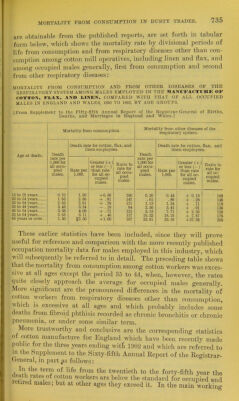
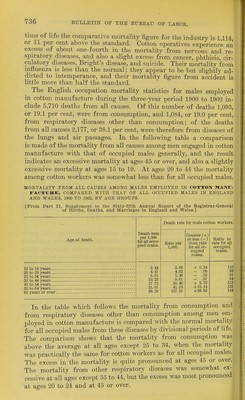
![tured, Which hardly warrants entirely safe conclusions, and the same IS true of the corresponding statistics of the Twelfth Census of the United States, which groups mill and factory operatives under tex- tiles, also without distinction of the kind of textile manufactured such as cotton, wool, flax, jute, etc. The Rhode Island statistics for the period 1897 to 1906 include 798 deaths from all causes, and of this number 218, or 27.3 per cent, were from consumption. In English occupation mortality statistics cotton textile operatives are combined with persons employed in the manufacture of flax and Imen, which also to a certain degree impairs their value. Since the proportion of persons employed in linen and flax manufacture is com- paratively small, the error is not a very serious one. In the aggregate the English data for 1890 to 1892 include the observed mortality ex- perience of 538,077 occupied males exposed to the risk of death one year, among whom there occurred 7,471 deaths from all causes. The specific death rates have been calculated by divisional periods of life, and an instructive comparison is possible with the corresponding mortality of occupied males generally. MORTALITY FROM ALL CAUSES AMONG MALES EMPLOYED IN THE MAIVUFAC- TUKE OF COTTON, F1,AX, AND I.INEN, COMPARED WITH THAT OF ALL OCCUPIED MALES IN ENGLAND AND WALES, 1890 TO 1892, BY AGE GROUPS. [From Supplement to the Fifty-fifth Annual Report of the Registrar-General of Births Deaths, and Marriages in England and Wales.] ' Age at death. Death rate per 1,000 for all occupied males. Death rate for cotton, flax, and linen employees. Rate per 1,000. Greater {+) or less (—) than rate for all oc- cupied males. Ratio to rate for all occu- pied males. 15 to 19 years.. 20 to 24 years.. 25 to 34 years.. 35 to 44 years.. 45 to 54 years.. 55 to 64 years.. 65 years or over 2.55 5.07 7.29 12.43 20.66 36.66 102.32 3.55 5.95 7.17 12.83 24.68 52.55 159.08 1.00 + .12 .40 4.02 4-15.89 -(-56.76 -t- -1- 139 117 98 103 119 143 155 The mortality of English cotton-mill operatiA^es, including workers in linen and flax, is shown by the preceding table to have been excessive at all ages, except 25 to 34. This is probably the result of the very heavy death rate prevailing at ages under 20, and the com- paratively high death rate at ages 20 to 24. The excess in the gen- eral mortality of persons employed in this occupation becomes more apparent at ages 45 to 54, and decidedly pronounced at ages 55 or over. It requires no very extended analysis of the causes of death among this class of operatives to establish the fact that the excess in the general mortality is primarily the result of a high death rate from consumption and other respiratoiy diseases. The facts, as far as they](https://iiif.wellcomecollection.org/image/b21359933_0112.jp2/full/800%2C/0/default.jpg)
 No text description is available for this image
 No text description is available for this image
 No text description is available for this image