Elements of the theory and practice of medicine ; designed for the use of students and junior practitioners / by George Gregory ... [etc.].
- George Gregory
- Date:
- 1835
Licence: Public Domain Mark
Credit: Elements of the theory and practice of medicine ; designed for the use of students and junior practitioners / by George Gregory ... [etc.]. Source: Wellcome Collection.
Provider: This material has been provided by The University of Leeds Library. The original may be consulted at The University of Leeds Library.
106/700 page 86
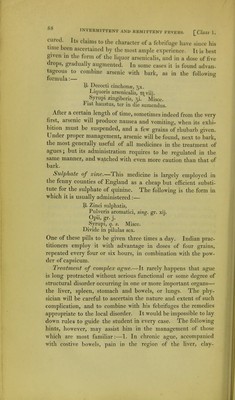
![^ IN'i'iiHMITTENT AND HEMITTENT KEVEnS. [rVrt-V* I . ]}j Infusi scniiiu compos. Jx. Potussa' tartratis, jiij, Tincturic sciinic, ^ij. Extracti glycirrhizae, 3i. Miscc. Under tliis plan of treatment many cases of acute ague terminate favourably after the third or fourth paroxysm, and it is not until this period that bark or any direct febrifuge medicine should be given. In chronic agues, that is to say, agues of long standing, assuming any of the types, but more especially the quotidian, quartan, or double quartan, recourse must l)e had at once to the most powerful means for checking fever with which the materia medica supplies us, more especially bark and arsenic. Administration of bark in ague.—Bark is most effectual, when recent and of good quality, when given during a state of perfect apyrexia, in the form of powder carefully prepared, in large doses, and as near as possible to the expected paroxysm. Much certainly depends on the quantity administered in a short space of time. All means therefore shovdd be taken to prevent its disagreeing with the stomach, or running off by the bowels. For this purpose it may sometimes be advantageously united with an aromatic, a few grains of rhubarb, or with opium; or the form of decoction and extract may be substituted for the powder. Modern pharmacy has given us a most efficient and elegant preparation of bark, in the sulphate of quinine, which in doses of two, three, or four grains, frequently repeated, may be fully relied on. The effects of the cinchona in the cure of ague are materially aided by its combination with a diffusible stimu- lant, especially the subcarbonate of ammonia, port wine, brandy, or some aromatic tincture. But there are certain states of the constitution which are found to interfere with the exhi- bition of bark in any form, and to counteract any good effects from it. The principal of these are, an inflammatory diathesis prevailing in the system, disorders of the priraae viae, obstruc- tions of the liver, spleen, and mesenteric glands, the direct con- sequence of ague, and lastly, the presence of other diseases not connected with the aguish disposition, such as bronchial inflam- mation. Kence arises the necessity of blood-lettuig, of piu-ga- tives, of saline and antimonial medicines, and of alteratives, particularly mercurials, cither previous to, or combined with, bark, accoxcUng to the circumstances of the case. J](https://iiif.wellcomecollection.org/image/b21536910_0106.jp2/full/800%2C/0/default.jpg)


 No text description is available for this image
 No text description is available for this image
 No text description is available for this image