Gray's school and field book of botany : consisting of "Lessons in botany" and "Field, forest, and garden botany" / by Asa Gray.
- Asa Gray
- Date:
- 1872
Licence: Public Domain Mark
Credit: Gray's school and field book of botany : consisting of "Lessons in botany" and "Field, forest, and garden botany" / by Asa Gray. Source: Wellcome Collection.
71/644
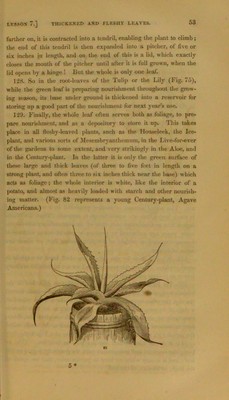
![LESSON 7.J THICKENED AND FLESHY LEAVES. farther on, it is contracted into a tendril, enabling the plant to climb ; the end of this tendril is then expanded into a pitcher, of five or six inches in length, and on the end of this is a lid, which exactly closes the mouth of the pitcher until after it is full grown, when the lid opens by a liinge ! liut the whole is only one leaf. 128. So in the root-leaves of the Tulip or the Lily (Fig. 75), while the green leaf is preparing nourishment throughout the grow- ing season, its base under ground is thickened into a reservoir tor storing up a good part of the nourishment for next year’s use. 129. Finally, the whole leaf often serves both as foliage, to pre- pare nourishment, and as a depository to store it up. This takes place in all fleshy-leaved plants, such as the Honseleek, the Ice- plant, and various sorts of Mesembryanthemum, in the Live-for-ever of the gardens to some extent, and very strikingly in the Aloe, and in the Century-plant. In the latter it is only the green surface of tltese large and thick leaves (of three to five feet in length on a 6trong plant, and often three to six inches thick nenr the base) which acts as foliage ; the whole interior is white, like the interior of a ]>otato, and almost as heavily loaded with starch and other nourish- ing matter. (Fig. 82 represents a young Century-plant, Agave Americana.) M 5 *](https://iiif.wellcomecollection.org/image/b28136615_0071.jp2/full/800%2C/0/default.jpg)


 No text description is available for this image
 No text description is available for this image
 No text description is available for this image