Oral anaesthesia; local anaesthesia in the oral cavity : technique and practical application in the different branches of dentistry / by Kurt Hermann Thoma.
- Kurt Hermann Thoma
- Date:
- [1914], [©1914]
Licence: Public Domain Mark
Credit: Oral anaesthesia; local anaesthesia in the oral cavity : technique and practical application in the different branches of dentistry / by Kurt Hermann Thoma. Source: Wellcome Collection.
Provider: This material has been provided by the Harvey Cushing/John Hay Whitney Medical Library at Yale University, through the Medical Heritage Library. The original may be consulted at the Harvey Cushing/John Hay Whitney Medical Library at Yale University.
118/156 (page 110)
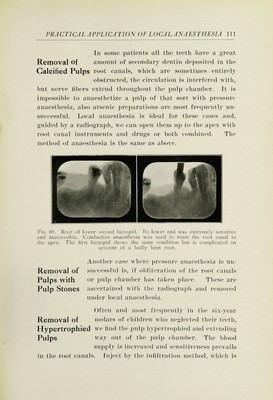
![posiire, do not add Avater but let it dissolve in the moisture secreting from the pulp. When it has become of the consist- ency of a paste, press it down with unvulcanized rubber. No pain is caused and the action occurs at once. When extracting the pulp one must realize that also the tissue around the tooth is anaesthetized, and should be careful not to injure the tissue beyond the apical foramen, this often causes peridontitis. Insert the broach to the end of the root canal and extirpate tlie pulp. Use sulphuric acid or sodium potassium treatment to remove all organic tissue from side canals and accessory foramina. The root canals sliould not bo filled the same sitting unless one ascertains the procedure and completion of the filling with a liberal amount of radiographs. Oil account of the aiiaestlicsia the co()p('ration of tlie patient is lost, and we liave no guide to tell lis wlicu tlie filling has penetrated tlirough tlie a])ex. Fig. 68. Centra! incisor with chronic abscess (lead filling), lateral incisor with pulpitis. Infiltration method was used to extirpate the pulps.](https://iiif.wellcomecollection.org/image/b21001418_0118.jp2/full/800%2C/0/default.jpg)